She was sucking my dick when suddenly she stopped to ask if I had given grandmother her medicine. I looked at her then laying my head back, my waist forward, extending my dick into her mouth, I said: “Yeah, five drops in half a cup of water.” She smiled, sucking once again, then suddenly lifting her head up: “Shit! Five drops! I said three drops!”
She ran out, snatching the robe off the ground, I followed her, putting my boxers on. The granny went into a comma. I called the doctor, he said take her to the hospital immediately, giving me the hospital’s number. I called them and requested an ambulance, I lost my erection. I kept checking granny’s pulse, as it fades away. We ran around the small apartment, bumping into each other as we dressed.
She got in the ambulance with granny’s body, as I followed them in my car. I was preoccupied with the radiant lines of red that gleamed over the corpse of the white ambulance. When we got to the hospital, I went to the reception desk to deal with the papers. She stood next to me tying up her hair. Her tears dried. She got closer to me and whispered in my ear: “I’m still horny.” We did it in the hospital’s bathroom, as granny kept dying.
No one foresaw that Ahmed Naji would be imprisoned for his novel. After all, no author had ever been subjected to arrest for morality reasons in modern Egypt, and as Naji himself says in this interview: “My writings are not political.”
The novel in question, Using Life (illustrated by Ayman Al Zorkany and translated from Arabic by Benjamin Koerber), reads like a colorful account of someone having a lovers’ spat with the city in which he’s lived all his life. That is to say, the book is full of intimate familiarity, occasional tender scorn, and a fervent curiosity toward city and man’s entwined fates that is also somehow coolly detached.
A Draft drawing by Aymen to “Using life”
Opening in near-future, post-apocalyptic Cairo, Using Life combines graphic novel elements and quirky characters to produce a portrait of a man making the best of life in a city on the verge of disaster. It is a rollicking read, at times zooming into dizzying detail (for example, a section illustrating Cairo’s various inhabitants), other times hurtling into madcap, breakneck action (secret societies! Ninja assassins!). Above all, the book is a bold depiction of a person pushing against the boundaries of their given life.
The novel passed the inspection of Egypt’s censorship board and was lauded by critics in Egypt and the wider Arab world. Then the unexpected began. In 2015, a private citizen lodged a complaint against Naji after an excerpt from Using Life was printed in Egyptian magazine Akhbar al-Adab. The private citizen, a lawyer, claimed that he suffered heart palpitations and a drop in blood pressure after reading passages from the excerpt describing cunnilingus. State prosecutors then took these claims seriously, and as a result Naji was sentenced to jail on charges that he “violated public modesty”.
As mentioned, his ordeal is extraordinary, marking the first time in modern Egypt that a writer has been incarcerated for their fiction. Zadie Smith puts it this way: “Naji’s prose explicitly confronts what happens when one’s fundamentally unserious, oversexed youth dovetails with an authoritarian regime that is in the process of tearing itself apart.” While imprisoned, Naji was granted the PEN/Barbey Freedom to Write award, which was accepted on his behalf by his brother.
In 2016, Naji was released from jail but subjected to a travel ban. In May of this year the ban was finally lifted, and Naji was able to leave Egypt. I caught up with him and translator Benjamin Koerber over email shortly after Ahmed Naji’s arrival in America.
YZ Chin: Glad to hear about the travel ban being lifted! How does that change things for you as a writer, if it does change anything?
Ahmed Naji: I’ve finally been able to travel and leave Egypt. I’ve now moved to the United States, where my wife lives, after we’d spent a full year separated from each other by the ocean and passport inspection officers.
I spent the two years after my release from prison in Cairo, and they were some of the most difficult years for me as a writer. First of all, I was under strict surveillance, and I was not allowed to organize any events or cultural activities. We failed to get official approval for the book launch event for my short story collection, which was published after I got out of prison. Only the Goethe-Institut, which is connected to the German Embassy in Cairo, offered to host the event.
Following the advice of my lawyers, I decided to keep away from publishing until the case was over. For the first time in my life, I felt the real weight of censorship. Even worse, I didn’t know what the red lines were. One time, I published an article on the band Mashrou’ Leila. Lo and behold I get a call from a friend who’s close to the security services, chastising me for the article and telling me they considered it a provocation since Mashrou’ Leila supports the Arab queer community, and that this sort of behavior could negatively impact my case and travel ban. Leaving Egypt now allows me to finally breathe and think freely, to test out my ideas, and reexamine everything that’s happened. I’ll finally be able to enjoy the company of my wife and the friends I have here.
But it also raises complicated questions for me: Is this to be a temporary, or permanent, departure? Am I to become a writer in exile? What does exile mean, now? If I stay here for a longer period, what will I do? What will I write about? Will I keep writing for an Egyptian audience, while living in America? Or will I assimilate to the new society and culture, change to writing in English, find a new ethnic or religious identity to subscribe to, and thus turn into one of those writers that talks about “Islam”, “the oppression of women in the Orient”, “the Arabs”, “terrorism”, and other such topics that captivate American audiences? For now, I’m trying not to think about all that, but I know I’ll have to face those questions soon.
For the artist to protect himself from confrontation with the institutions of power and all their violence, he has the three options that James Joyce prescribed for the writer: “lying, exile, silence.”
YZC: I’m very happy to hear that you are reunited with your wife. Sounds like you’re understandably at a difficult crossroads writing-wise. I get the reluctance to become a mouthpiece that caters to American appetite or biases. Are you concerned America will change you or pressure you in ways beyond that pigeonholing?
AN: I’m always ready for change. So far, I’m optimistic and open-minded about this American journey. My first concern is to learn — to understand this country, to take it all in and figure out its rhythm — and through this I’m sure I’ll find the right place for me. I’m lucky because I have a large number of friends here who are writers or work in the cultural or political fields. They’re providing me with support, and the keys to understand the nature of the scene here.
YZC: Do you think there’s also a risk of being pigeonholed as “the writer who went to prison?” As opposed to, say, “the writer who writes about finding joy in a depressing city and the fearsomeness of killer ninjas.” What would you like to be known for as a writer?
AN: I hope to be known as the writer with a thousand faces. I’d be very receptive to any of these labels or classifications. The writer’s challenge, in my opinion, is his ability to open up to the world, to change, to embark on new adventures, and to create new works. The writer that went to prison, the writer who writes about a depressing city called Cairo, is the same writer that might tomorrow write about intrigue and power play in Washington, D.C. Or he might write about a girl’s education in America. Anything is possible. My appetite’s ready for all trials and experiences.
Two days ago, I was talking to Yasmine [Naji’s wife] about something, and said, “As exiles, we don’t have the luxury of holding on to a lot of memories.” The thought terrified her. It hadn’t really set in yet. “Oh my god, we really are exiles,” she said. I tried to lighten the both of us up by focusing on the few real benefits of exile, like the unbearable lightness of being, and the freedom to remake one’s self and one’s image. Exile provides the opportunity for a new beginning, and there’s nothing more thrilling for me than new beginnings.
Exile provides the opportunity for a new beginning, and there’s nothing more thrilling for me than new beginnings.
YZC: As a writer who grew up in an atmosphere of state censorship, I struggled for a long time with self-censorship. Have you had any previous run-ins with the Egyptian censorship board? How do you grapple with the possibility of censorship when you write?
AN: I think a big part of writing is struggling with, and figuring one’s way around, the many forms of censorship that exist. The political censorship exerted by the state is a concern of course, but I never confronted it before the trial. My writings are not political and I was not interested in clashing directly with the state; I hadn’t thought that sex worried them very much. The greater pressure, the form of censorship that I feel impacts the writer more, is the censorship of society and the family. This form of censorship burrows under your skin, without you ever feeling it. It sometimes becomes impossible to confront or to expose, like the censorship that imposes itself under the name of political correctness.
YZC: That rings true for me, the existence of censorship that never gets registered. So you’re saying there needs to be constant self-exploration to understand the pressures that are placed on us. In that case, I’m curious if you think it’s possible to deliberately cultivate our influences as a countermeasure, like garlic against vampires? If so, what is or would be your garlic?
AN: In such circumstances, the garlic can be prepared a number of different ways.
1 — Listening closely to one’s own personal desires and pleasures, however forbidden or prohibited they might be, however useless they might be to society or the “wheel of production”. No impulse should be suppressed, nor should you run after it like a teenager. You just need to listen to it, then take your time polishing it, until the desire turns into a will.
2 — Don’t put too much trust in psychology or self-help doctrines. Do you really think all these books, programs, and talk shows want you to succeed? Do you really think that the secret of happiness can be sold with a holiday discount? Believe me: except for your mother, no one’s really concerned about your happiness and self-interest.
3 — Whatever you do, don’t let them catch you. In Egypt we have a nice little proverb that says, “Fuck the government but don’t show them your dick”.
4 — Always practice in front of the mirror first. A few days ago in D.C., there was a small demonstration of Neo-Nazis and white people. It was really quite small. Facing them was a counter-demonstration of mostly African Americans and anti-Nazis, which was huge. The Nazis, surrounded by police, were waving flags; they were vastly outnumbered by the counter-demonstrators. In spite of this fact, they were marching with full faith in the protection offered by the police. Their demonstration ended before it began, and they quietly left amidst the shouts of the counter-demonstration. The question I kept asking myself was, “What were they [the Nazis] thinking? Did they consider what happened a victory for them?”
YZC: There’s an interesting passage in Using Life where the character Ihab thinks about art: ‘Might not the “truth” of art conflict with its duty? That is to say, the duty art has to be functional?’ It certainly seems that to censors and some readers, art has a duty to uphold morals. What are your thoughts on the duty of art?
AN: Morality is not constant, it’s constantly changing. Otherwise, we’d still have the morality of the nineteenth century that held African Americans in the cotton fields and women in the kitchen. Permanence and stability are illusions. The world and human consciousness are in permanent motion, and the writer is part of this motion. The power of art lies in its ability to strip off the moral veil that society’s institutions impose under the pretext of stability or observing morality. When that happens, art performs its role vis-à-vis the individual by upsetting the ideas and convictions that one has been raised with. Art also performs its role vis-à-vis society in helping to change the prevailing morality.
Of course change doesn’t happen easily. The art that performs these roles puts itself in open confrontation with the institutions of power and all their violence. For the artist to protect himself, he has the three options that James Joyce prescribed for the writer: “lying, exile, silence”.
The power of art lies in its ability to strip off the moral veil that society’s institutions impose under the pretext of stability or observing morality.
YZC: When I saw David Bowie listed in your novel’s Acknowledgements page, I immediately thought it was very apt because Using Life is such a rollicking and at times surreal read. Best Bowie song?
YZC: Using Life flirts with fantasy and magical realism, and of course graphic novels. Do you see more possibilities and avenues for expression in blending genres? Will you continue working across genres?
AN: I hope so. One of the faces I’d like to be known by is that of fantasy writer. Comics for me are my eternal dream. I’m a big fan of comics. None of my current projects involve comics, but I have a file full of dozens of stories and ideas that are just waiting for the right artist to execute them. I have the ambition to write a massive graphic novel, which I hope to realize some day.
Today marks a “Day of Blogging” for Egyptian novelist Ahmed Naji, who is serving two years in prison: guilty of having written the playful, language-rich, genre-crossing novel Using Life, he will be given the PEN/Barbey Freedom to Write Award, today, in absentia, in New York City. When Naji was charged with “violating public morals” for an excerpt of his novel published in a journal, he initially won his case, but lost an appeal and has been in jail since February 20.
Below, Ben Koerber reflects on the play in using life.
Aymen drawings from “Using Like”
…The mother that reads a story to her child: this is resistance. Building a small house: this is resistance. Singing at night is resistance. Having sex is resistance. Resistance is not just bearing arms; it is also the ability to adhere to the virtue of play, and to pursue–promiscuously, and with an eye to passion and pleasure–methods for using life…
I recall Bisu saying something to this effect some ten years ago.
July, 2006: Lebanon had been invaded again by the Israeli army after clashes with militants from Hizballah. A debate was raging in the Egyptian blogosphere on strategies for solidarity with the ordinary Lebanese citizens caught in the crossfire. “Resistance” was the rarefied term that Hizballah used to refer to the bullets and rockets it fired randomly southward. Bisu, blogging from somewhere in or around Cairo, had a different understanding of the word.
Like most people, I knew Bisu before I knew Ahmed Naje. The former was for a time the trickster-protagonist of the blog “Wassa’ Khayalak” (“Widen your Imagination”), and was known for his devastating parodies of state-sponsored intellectuals, producers and consumers of kitsch, religious hypocrites, as well as other bloggers who took themselves too seriously. (The name “Bisu” is explained as a pseudo-diminutive form of Iblis or “Satan”; before knowing any better, I sometimes imagined him as sprightly little smug-faced sanfur – Arabic for “smurf” and an occasional topic of Bisu’s posts). That was all back during the heady days of what Ahmed Naje, in his history of the Egyptian blogosphere, refers to as the “Diluvian Age”: a period of glorious cyber cacophony that lasted, roughly speaking, from the suppression of anti-Mubarak protests in 2005 to the draining of writers away from blogs to Facebook and Twitter a few years later. Sometime in late 2009, Bisu transformed, or molted, or something, into someone called “Ahmed Naje,” which also happened to be the name of a journalist, editor, and novelist in real life. There was no great “coming out” ritual here, only a courteous nod of admission to what many readers had already begun to suspect.
Fortunately, little else changed, and the blog stayed true to its slogan, “Live like you’re playing.” Bisu’s ludic imperative about the virtues of play were with me when I began to translate Ahmed Naje and Ayman Zorkany’s novel, Using Life, in late 2015. Something I had read in graduate school by Roland Barthes about interpretation as “play” seemed to recommend itself in my efforts at self-justification, but I was happy that Bisu’s sporadic use of the term was possessed of a more immediate vitality, and beckoned with the warmer and more inviting ontology of the nonce-concept. Barring some orange-haired apocalypse in November, my translation of Using Life is on schedule to be released by the University of Texas Press early next year. But though it may serve as the original work’s primary representative in the English-speaking world, I would urge we consider it as just one “play” on the book written by Ahmed Naje and illustrated by Ayman Zorkany.
The English-language play on Using Life has been preceded by many others, in different idioms and media.
There are Ayman Zorkany’s illustrations, which both complement and “translate” the text written by Ahmed Naje. Some of these may also be viewed on the Arabic book’s Facebook page.
Looking further back in the Arabic tradition, one may contemplate the uncanny resemblances between Zorkany’s illustrations and the monstrous hybrids of Zakaria al-Qazwini’s 13th-century Wonders of Creation manuscripts.
Curiously, while moral panics surrounding comics in the United States have historically targeted the genre for their graphic content, the illustrations in Using Life have not featured prominently in the recent legal controversy; perhaps this is because Zorkany’s images, while seemingly grotesque, are only so to eyes not accustomed to the realities of urban decay in contemporary Cairo.
There is Using Life merchandise. The book’s publication in Egypt coincided with an exhibit held at the Medrar artists’ collective in downtown Cairo (Nov. 24 – Dec. 1, 2014), which featured Zorkany’s drawings in a variety of printed formats, including T-shirts, hoodies, pins, coasters, and coffee mugs. These items were available for sale until recently at Cairo’s Townhouse Gallery, which has been subject to raids, closures, and partial demolitions by various state agencies.
There are interpretive dance performances. The cultural center Darb 1718, in Cairo, hosted one in late 2015, which, though I attended, cannot now find a trace of on the interwebs.
There are critical reviews. An important context for playing with Using Life and understanding the surrounding controversy are several not-yet-translated articles by Egyptian artists and academics. Some appeared in a recent issue of the Cairo-based literary review ‘Alam al-Kitab (“Book World,” no. 94/95, Nov.-Dec. 2015); for example, the intriguing essay by poet Ahmed Nada compares the trial of Using Life with that of Allen Ginsberg’s “Howl,” a poem which has been translated into Arabic by Yusuf Rakha (in his recent novel, The Crocodiles, itself translated from the Arabic by Robin Moger), and before him by the inimitable Iraqi poet Sargon Boulus.
Lastly, or rather primarily, Using Life (Istikhdam al-Haya in Arabic) is itself a translation, in textual medium, of the aesthetic and architectural work that has conspired to design contemporary Cairo.
One of the great ironies of Naje’s imprisonment is that such direct and draconian displays of state power are largely peripheral to the critical concerns expressed in his novel. Instead, Using Life directs the reader’s gaze at the more subtle mechanisms of repression and constraint at work in contemporary Egypt: the perfidy of friends and lovers, the “kitschification” of culture, and, most importantly, conspiracies wrought in the realm of architecture and urban planning. The book is a play, in the first place, on the utterly unlivable state of today’s Cairo – “a miserable, hideous, filthy, rotten, dark, oppressive, besieged, lifeless, enervating, polluted, overcrowded, impoverished, angry, smoke-filled, simmering, humid, trashy, shitty, choleric, anemic mess of a city,” according to the protagonist, Bassam Bahgat.
Let the reader be aware that among the city’s current residents, Bassam’s feeling is far from unusual. Cairo’s decades-old crises in housing, electricity, waste management, and traffic (to name a few) have left the city both physically and psychologically scarred, and have remained unresolved amidst the waves of revolution and counterrevolution unleashed since January 25, 2011. The intervention of the security services into urban planning has disfigured the city even further: un-breachable metal sidewalk fences, forcibly depopulated public spaces, and huge, concrete block walls constructed in the middle of major streets are now familiar sights around the capital.
Yet as parts of Cairo have shut down, new aesthetic practices have emerged over the last decade to open new spaces for expression, as well as to re-purpose old ones. Graffiti artists have laid claim to the city’s walls and barriers. Comedians and cartoonists have attracted cult followings through YouTube, and bloggers have emerged from the obscurity of their bedrooms to pioneer new literary genres. In fashion, advertising, and graphic design, independent artists have made spectacular interventions in fields traditionally dominated by foreign brands.
In Using Life, Zorkany and Naje have managed to synthesize many elements of this resurgent urban culture into something that, together with its “translations,” may serve as a guide-book of sorts for playing Cairo. All of these “plays” of/on Using Life – which, incidentally, were all performed or published before Ahmed Naje was sentenced to two years in prison – not only constitute forms of translation more inventive than the linguistic plays of professional interpreters, but that they also offer models for those contemplating solidarity in a manner suggested by the playful work itself.
Multimodality is not new to Egyptian culture whose ancient sign system was the hieroglyph (Lambeens & Pint 240); correspondingly, ancient Egyptian two dimensional mural art was at times sequential, illustrated by hieroglyphic inscriptions. Moreover, a bas-relief dating to the Old Kingdom circa 2,000 BCE at Cairo Museum may be considered as the earliest pictorial cartoon, according to Afaf L. Margot. It bears political insinuations by depicting a conflicting relationship between the keeper and the sacred baboons in his charge (Margot 3). Later, Coptic and medieval Arabic manuscripts combined text and image (Coptic Museum). In modern times, Egyptian cartoons evolved in the second half of the nineteenth century with the founding of newspapers in 1870. Their political humor was strongly connected to the growing antagonism against rulers (Margot 2).
2Children’s comics in Arabic flourished in Egypt as early as 1923 with Al-Awlad (Children), an eight–pages–long black and white newspaper, to be followed by Katkot (Chick) with serialized comic strips that have developed, ever since (Nadim Damluji 2016). The emergence of the first graphic novel by Magdy El Shafee met great obstacles for being considered by the authorities as “infringing upon public decency.” It was banned under article 178 of the Egyptian penal code criminalizing such publications. Author and publisher were put to trial and had to pay a EGP 5000 fine. It was translated into English by Chris Rossetti (2012), and later reappeared in new Arabic editions. Censorship was growing apace during the Mubarak era, and graphic novels employed text and image to flout conventions by exposing the authorities despite the censored environment.
3Graphic novels have gained popularity with the 2011 uprising in Egypt. More graphic novels have appeared since, such as Ahmad Nādī, Ganzeer, and Donia Maher’s The Apartment at Bab El Louk (2014), winner of a Mahmoud Kahil Award. Bab El Louk is a Cairo district close to Tahrir Square where the Egyptian uprising took place. During the uprising, Tahrir Square turned into a “carnivalesque” performance stage intermediating aural, verbal, visual, and digital, blending media and performance, most of which had political insinuations. In Mikhail Bakhtin’s terms this would be considered as “carnival” upturning social hierarchies. Tahrir Square became more of a mūlid (folk fair) location, where performances became similar to the Bakhtinian marketplace, combining “loud cursing” and “organized show… imbued with the same atmosphere of freedom, frankness, and familiarity” (Bakhtin 1984a 154), thus balancing social differences.
4The carnivalesque blending of media and performance, the pairing of (temporal) language and (spatial) image brings us back to Bakhtin’s theory which examines the utterance within the genre; this has been related by some critics to the combination of media. Gunther Kress has argued for a semiotic dimension of genre systems as combining varied activities within a medium. He starts off by proposing language as a multimodal medium (Kress 185), and all texts as multimodal (Kress 187). This multimodal approach to all texts or forms of communication shows that different modes have various potentials and limitations, and are articulated in specific ways in different cultures.
5In a similar argument, Lars Ellestrom propounds that all “‘texts’ and ‘systems’ overlap,” being parts of material, sensorial, spatiotemporal and semiotic aspects,” which he calls “the four ‘modalities’ of media.” Subsequently, “all forms of art, media, languages, communication and messages have some characteristics in common,” allowing them to merge without dissolving (Ellestrom 10). Mark Evan Nelson and Glynda Hull have noted that Bakhtin’s theory on the multimodal “chronotopes,” the time-space conjunctions (Bakhtin 1981), may be considered as precursors to the interpretation of multimodality merging multifarious potentials in media. They have concluded that synthesizing several theories in a study within this scope enables a better understanding of a multimodal novel ( Nelson and Hull 416-417). Multimodality has challenged the borders separating media and has opened new forms of cultural practices and analysis that cross borders. It has promoted new strategies for collective engagement in a mediated world, creating a space for cosmopolitan repercussions.
6Departing from traditional trends, experimental fiction proliferates in a cultural context where several forms of sign systems and media overlap. The carnivalesque environment referred to earlier that evolved with the Egyptian uprising has brought together creators from different social and cultural communities. Ahmed Naji’s (1985) and Ayman Al Zorkany’s (later Zorkany, 1982) Istikhdāmal-Hayãt (2014, Using Life) is a multimodal novel challenging borderlines dividing classical and contemporary verbal narratives, comic strips, popular music, and film-making. It moves freely between the classical and the popular, as well as between world and local cultures (later referred to as UL). The popular has acquired global dimensions with the spread of information technologies, science fiction, and cyberpunk sub-genres, even among subcultural groups living at the margins. Verbal and visual overlap, enticing the reader to meander visual, verbal and musical rapport, communicating thematic connections on multiple levels simultaneously. Indeed, as Ellstrom argues, “intermediality is a precondition for all mediality” (Ellestrom 4).
7By transgressing boundaries, verbal narrative and visual text contest plot-line consistency, as well as sequential chronology in graphics, which problematizes a critical reading of the novel within a single theoretical methodology. Any critical approach has to be shaped with relevance to the experimental nature of the creative work within its cultural context. Subsequently, I will draw from several critics that range, among others, from Mikhail Bakhtin, to Thierry Groensteen, Gunther Kress and Pascal Lefévere.
8Naji writes and Zorkany draws. Both are experimenting with mainstream novels and comics conventions, subverting the role of the Western superhero as well as the popular Egyptian arch-villain to articulate a futuristically fantasized estranged world. The objective of this paper is to explore strategies of engagement in UsingLife, a multimodal narrative, combining fiction, non-fiction, graphics and lyrics. It will trace modes of going beyond standardized formal conventions, breaking away with habitual reading protocols of classical Arabic and mainstream Egyptian fiction to create a culture of dissent. Besides the informal practice in the verbal text, of blurring boundaries among various language registers in Egyptian everyday spoken language, it merges professional and amateur writing. Correspondingly, Zorkany’s comic strips break with the artistic hierarchy set by the College of Fine Arts since its establishment in Cairo in 1908. Unlike the aestheticism of Fine Arts, comic strips hold an oppositional potential interrogating habitual modes of viewing. Furthermore, Zorkany drifted away from the drawing styles commonly used in Egyptian comic artists. His comics have a wider range of drawing/shading style, and panel composition.
9Naji and Zorkany have closely collaborated to synthesize verbal and visual; they have welcomed readers’ critical interaction, as acknowledged at the end of their book. In fact, the visual and verbal narrative strategies used, subvert the expectations of readers habituated to mainstream fiction, and graphic novels pandering to traditional tastes. They had to face the challenge of appealing to a wider and more varied audience, a multiplicity of cultural sources, and a wider range of artistic styles, ranging from cartoons, illustrations, and graffiti to commercial ads. The far reaching economic and social changes in Egypt as a consequence of globalization policies have formed a pluricultural society. This has unsettled mainstream culture and valued principles of all cultural groups. Verbal language has been affected mostly, and the visual took precedence with the spread of communication technologies. Subsequently, this has introduced new potentials for engagement with the world.
10A society that is constantly disoriented as a result of rapid changes effected by unknown sources is in constant need to relate. Moreover, the proliferation of the graphic novel as a multimodal form came in response to an urge to engage with the world through an immersive form. According to Kress, multimodality brings to our notice that perception is the result of the human body’s engagement with the world through the senses. The fact that the senses coordinate together “guarantees the multimodality of our semiotic world” (Kress 184). For Pascal Lefévre, the sensual is experienced through form: “The first and foremost dynamic process of form is engaging the feelings of the reader” (Lefévre 5). The fact that the body provides the means of engagement with the material world, would relate multimodality to “the issue of subjectivity” (Kress 187), and ways of its engagement with the world. Multimodality may be thought of as an epistemological tool invoking the reader’s interaction in order to rethink complex local global relations ensuing from the clash between global technological politics and parochialism in an uneven world. Today’s reader is a global and local citizen located at the crossroads of cultural encounters, and contemporary writers worldwide have become aware of limitations inflicted by traditional artistic forms, as well as the difficulty in relating to a single national culture. Subsequently, multimodal creative works worldwide are hardly confined to one literary or artistic tradition. Such is the case with Using Life (2014; later UL), the work under study.
11The novel’s title, Using Life is an appropriation from the Roman poet and philosopher Titus Lucretius Carus’s (c.99 CE-c.55 CE) poem, The Nature of Things: De Rerum Natura, which is based on Epicurean philosophy. An epigraph appropriated from Lucretius is quoted in the book’s front-matter pages. The epigraph quoted in Arabic translates as follows: “Birth-giving reccurs on and on; life is not given for possession but for use” (UL 5). Naji’s appropriation of an ancient western classic, his merging of the local with the global, his mix of establishment with popular cultural products, and placing events in a contemporary setting endow the novel with a cosmopolitan context. The narrative events take place in cosmopolitan Cairo, configured as an unreal/real City that may represent the monetizing hurly-burly of any metropolitan city. However, the narrative subverts the call for “using life,” advocated by the book’s title and the Lucretian epigraph by failing to affirm them. Unlike Lucretius’s poem resplendent with natural imagery and sensuality promoting intellectual pleasure, the preponderant imagery in the novel is that of a yellowish desert, sometimes orange at its best, and that of a ravaged Cairo razed to the ground.
12As opposed to Lucretius’s birth-giving nature, the events in the novel are stirred into action by a geographical catastrophe—a devastating desert tsunami inundating Cairo under a sand avalanche, along with a deadly massive earthquake causing streets and bridges to break down, land and ground to fall down and eventually, the collapse of the pyramids; Cairo is immersed in an overwhelming agony, a bewildering pathos. The language used to describe the tsunami appropriates that of the sacred texts, with phrases like “the wrath of god” and “Heavenly damnation,” relating the overwhelming situation. Again, as in The Nature of Things, the element of chance—not divine intervention—is persistent, however, paradoxically, disabling the natural use of life.
1 * Editor’s note: the graphic’s allusion seems to be to David’s “The Death of Marat.” A reference to (…)
13The presence of death in life initiated in the verbal narrative, is visually configured by a graphic design in a two-page spread with a caption appropriated from the Natasha Atlas’s lyric: “You’re looking for paradise, while it surrounds you” (UL 12-13). Instead of an enchanting landscape illustrating the lyric’s words, the graphic drawing is of a devastated bathroom. The drawing is in shades of grey and a predominantly obscure background. Streaks of light emanating from an unknown source make visible a toilet, a tub overflowing with a bloody liquid, sharp-cutting metal tools, and female underwear negligently thrown.1 The prevalence of decay is heightened by the use of stark chiaroscuro. The contrast of light and deep shades adds a claustrophobic noir atmosphere. The image may be viewed from another perspective as, to use Thierry Groensteen’s terms, a “tabular surface,” for spatial relationships, (Groensteen 13). The contrast between the white typography placed at the top of the drawing and the black background heightens the contradictory relationship between the meaning of the lyric and the visual affect. The sharp contrasts in shades, along with the deformed non-representational objects, function as tools to immerse the viewer in apprehensive emotions (Fig. 1).
14Subsequently, the graphic spread cannot be viewed as a comic strip; the textual code emerging from the obscure space is deliberately disrupted by the gloomy environment evoked by the grey shades and sharp contrasts. The visual function of the typography becomes more active than the textual code in the lyric. The graphic drawing plays a double function: its placement at the beginning of the novel anticipates traumatic forthcoming events. However, once retrieved by memory along the flow of events, it impacts retrospectively, especially towards the end. The opening graphic spread disrupts the code transmitted by Natasha Atlas’s lyric, subverting the embedded meaning. The comic strips that follow are not set in consecutive order to create an alternative narrative; nor are they used as illustrations to the verbal texts. Conversely, they are as disconnected as the narrative text, at times supplementing the inarticulate in verbal language. The sparing snatches of dialogue in the subsequent strips are by an anonymous narrator, who even disappears from several sequences. Unlike classical comics that impose verbal on visual, the panels are generally self-sufficient, following what Groensteen propounds as a “poetics of reticence, ambiguity, and indeterminacy” (Groensteen 30).
The third verbal text following the graphic spread is an entry on Ibn ‘Arūs, a medieval Upper Egyptian folk singer who turned from his life as a bandit to become a popular lyricist upon being jilted at the age of sixty by the young girl he loved. Ibn ‘Arūs’s lyrics are sung to this day at local fairs, or festive occasions in Upper Egyptian villages, by Shawqī Qenawī, a contemporary popular ballad singer, also mentioned in the entry on Ibn ‘Arūs. The dates and national origins of Ibn ‘Arūs are not definitive, as the narrator claims that information descending from ancestors and exchanged among contemporaries is liable to constant modification along the ages. The insertion of this entry pseudo-documenting the lives of both popular singers ji lted by their lover[s] function as commentary on the previous episode recounting Bassam Bahgat’s—the protagonist narrator—disappointment as a result of his partner’s betrayal; parallel situations in the novel intensify elements of indeterminacy and chance. The multimodal use of text, graphic design and popular music to map related private agonies among members of different social communities, enhances the sensation of “tsunami” morbidity on the local horizon. The second chapter extends this morbidity to the international horizon with texts and graphics critical of private and public Western modes of living. Enhancing sensations by the use of three modalities of media–verbal, visual and aural–simultaneously immerses the reader-viewer in the narrative experience.
16Instead of a chronological plot-line, a series of episodes are spread along ten chapters, alternating verbal narrative, graphics or comic strips, as well as popular musical extracts. As verbal narrative visual comics and musical excerpts do not proceed in sequential order, they are mutually interruptive. Shifting visual, verbal and musical effects requires a pause, which disrupts narrative time and space. The verbal and visual are not attributed meaning in isolation, but relative to their occurrence in the text, and depend on the connections made in the process of reading. Multimodality or the use of multifarious media as referred earlier, coincides with the time-space “chronotopes,” hence merging different historical temporalities and diverse locations.
17The novel evolves through multiple temporality, and plurality of cultural narratives. Narratives from Cairo’s past and present are related, to provide a background for ongoing events in the protagonists’ private lives. In one of his interviews, Naji rightly opines that, “Cairo is a museum holding a plethora of historical buildings” (Ali 2014). Cairo residents daily commute along different phases of history marked by distinct architectural constructions and monuments, at times merging with shanty towns and popular districts. Past and present are active in the everyday life of ordinary Cairo inhabitants. Along with the presence of the historical past, the present has provided technological devices introducing parallel realities. Subsequently, events in the novel alternate inadvertently along the protagonists’ private lived time and simulated reality. Correspondingly, Cairo’s surviving monumental architectural constructions provide a cultural context of lived pasts, surrounding commuters, along with mediated pasts diffused through the media. Within the private domain, there are lived, recounted, dreamed and simulated times. By the same paradigm, Cairo is being lived as embodied space, and as virtual space. Inadvertent shifts in experiencing material and virtual realities in private and collective memory are one of the strategies used to destabilize progressivist ideologies. The shifts are prompted by environmental degeneration, social instability, abjection, and failed projects. Contingent cultural transformations make it difficult to mobilize a narrative of private or collective history on a single axis, which explains the plurality of cultural narratives on Cairo and of its inhabitants. These narratives are inserted in the action as comments on ongoing situations linking Cairo’s past history to present actualities, in the same way protagonists reflect on their past lives in present sociopolitical situations.
18Cairo has taken on several faces; the cityscape has undergone several changes under successive rulers. This is also configured in the changing roles of Egyptian women acting as traditional veiled women (Fig. 2) or unveiled modernized funky women (Fig. 3). These seeming binaries come along a series of graphic drawings. In a chapter titled, “The Animals of Cairo,” a variety of male and female figures are featured combining grotesque human and animal features; they are named: “the Scoundrel,” “Stray Dogs,” “Dervishes,” “cockroaches,” among others. Verbal and visual text subverts these stereotypes by revealing their complexity, making it difficult to stigmatize them under one appellation. They configure an identity crisis incapable of coping with new demands from the altered social and economic changes. Both veiled (UL 90) and unveiled women (UL 92) fail to find a balance between developing their distinctiveness while still fitting in. Unlike former graphics combining visual and verbal in one panel, in this series, the verbal and visual are split into different panels to be read and viewed separately.
19Identity in crisis is a consequence of the persistent tradition/modernity conflict predominating the history of Cairo’s architecture, cultural heritage, as well as social relations, and has been configured in different strips. This conflict has never been resolved either in Cairo’s urban planning, or in the lives of its residents. The tradition/modernity conflict is further developed towards the end of the novel; a sequential panel features a televised story of a worker at a printing press, who abandons his wife after becoming emotionally attached to the printing machine he works on, and fantasizes about having a sexual relationship with it (UL 156-161). It is a humorous strip with multiple cultural specific connotations. Most of the panels are in a grotesque style, merging reality with fantasy; they convey a visual metaphor, alluding to inability in managing technological advancement to meet habitual living, or difficulties in reconciling rationality and affect. It may read as a tragicomic sequence, which adds to the ambiguity of the situation instead of clarifying it.
20The disconnected segments configure a lurking catastrophe which the reader/viewer apprehends as early as the opening chapters, especially that the opening episodes, graphics and musical extracts manifest the end of Cairo, the sad finale, before starting the narrative leading to this end. The reader is gradually led to sense a double risk lurking in the urban, ecological and sociopolitical environments. While the sociopolitical and environmental conditions of Cairo predict an inevitable disaster, later configured as a sand tsunami, its geopolitics is being manipulated by an economic strategy planned by the International Architects Association. This multinational Association is planning to sweep off Cairo City to have it replaced by a New Cairo. Cairo has always been designed by successive rulers to become the center of power. Moving the center of power from historic Cairo to a “New Cairo” by an international association of architects is of significance. The Association is a “global player,” an “outsider” economic and a political actor and not the choice of local inhabitants. Its political activity beyond governmental control has increased the vulnerability of the system, which brings about Cairo’s devastated condition. The latest previewed transformation by the Architectural Association claiming to have worked with reference to stored archived material lacks solid credentials, and their work turns out to be drawing a virtual map of New Cairo, a map that, “precedes the territory–precession of simulacra–that engenders the territory […]” (Baudrillard, from “The Precession of Simulacra,” 1981). Environmental degeneration and globalizing capitalism work concurrently. Towards the closure, global capitalism overlaps with crime increasing the threat, which is marked by a series of mishaps. Inadvertent events occur, such as the mysterious disappearance of Maud, one of the protagonists, the discovery of traces of a crime in the Association underground offices, and the frozen human flesh discovered by Bassam in Moonie Moon’s refrigerator. The horrendous verbal images recuperate the prelude graphic spread featuring a tub floating with a bloody liquid in an abandoned bathroom. On one level, the closing events relate to the queries raised by the opening spread; on another level they raise additional questions as to the identity of the assassins and their intentions; together these reiterate the limitations of verbal and visual language to be fully articulate. The ambiguity of both verbal and visual languages, their inability to articulate a consistent plot-line configures Cairo’s devastated condition as well as the chaotic condition of its inhabitants.
From Using Life @ Zorkany
21The speculative architectural project of New Cairo undertaken by the International Architects Association, created in response to a capitalist transnational scheme, intertwines with the fictional narrative (Plesch 145) recounting the interment of Cairo as a consequence of a devastating sand tsunami. The environmental disorder configures degenerating social relations, chaotic governmental policies and lack of governance. The verbal and architectural narratives critique centralized planning, cultural globalization, digitalization and monetization. This is rendered in the third sequential panel (Chapter 3), featuring Bahgat’s first encounter with two members of the International Architects Association, who commission him to make a film on Cairo’s architecture (UL 37-41). The different postures of standing outsider and seated insider, commissioner and commissioned, self-assuredness and incertitude are rendered by focusing on posture and facial expressions. While Bassam’s posture conveys helplessness, his eyes reveal anxiety and negative affect (Fig. 4). Conversely, the Association members’ blank eyes shaped in straight, circular and interwoven lines convey a tunnel vision (Fig. 5). This blank look creates a gap revealing the complexity of the relationship, whereby one party’s inner emotions remains ambiguous; in that sense the images become performative as they immerse readers in the action.
22The presence of Ihab Hassan (1925-2015), the U.S.-American-Egyptian postmodernist critic, as a member of the International Architects Association is an implicit subversion of the postmodernism Hassan advocates. The construction of a New Cairo according to a simulated map designed by an international association, is totally divorced from Cairo’s cultural history, and marks the failure of a postmodernist approach claiming its inclusiveness of cultural difference. Conversely, Bassam Bahgat, protagonist-narrator and his friends, contest the Association’s rationalized globalizing scheme by leading the life of the flaneur. This mode of living also challenges the popular—turned—elitist postmodernist approach which had initially subverted rationalized modernization, but has later turned into theorization. The turn from live experience in an old Cairo throbbing with life, to the theorization and simulation of a “New Cairo” that replaces the old impedes the natural process of living. Subsequently, this explains Cairo’s eventual devastation by an unprecedented sand tsunami.
23However, the life of the flaneur does not promote the natural process of living either. Frustration with the flaneur’s mode of living is rendered in the fourth comic strip (UL 71-78), configuring the impact of hasheesh on Bassam, the protagonist-narrator in the spatial graphic mode. Bassam is rendered in a condition of temporary amnesia that dissociates him from material reality, carries him afloat a paper boat sailing on a sea of dreams. The journey proceeds along downfalls and lifts, sinking in the sea, and flying in an air balloon, until he finally lands on a desolate location. The strip is made of a series of single images most of which are without captions, or with onomatopoeic sounds like the “crack” of the collapsing paper boat (Fig. 6). One does not view the panels in terms of before and after; the reader draws the meaning by reconstructing a simultaneous relationship connecting different images. Bassam’s distraught condition materializes with the sudden appearance of an unknown person giving him back his lost purse. Instead of thanking him, Bassam resents the stranger’s help, and responds with abusive language. Bassam subverts the superhero image; his life as flaneur indulges him in half- accomplished pleasures. However, his indulgences cannot be classified as negative affect, as they are among the few choices offered in a censored environment.
24The Bassam Bahgat-Ihab Hassan dis/alliance renders the paradoxical relationship dis/ connecting dissenting intellectuals from the masses. Hassan’s presence is reminiscent of similar politico-cultural circumstances that have, with variation, previously taken place in Cairo’s history. Ihab Hassan emigrated to the United States in 1946, when Cairo was metamorphosed by Khedive Ismail to become “part of Europe,” engendering a cosmopolitan cultural environment. These were times when Egyptian Surrealists were at the peak of their performance; while closely connected to the International Surrealist movement, Egyptian Surrealists failed to achieve some of their aspirations in a cultural climate torn between modernists and conservatives (Kane 10-12). Similarly, Hassan, the postmodernist critic, while fully integrated into the American culture was totally divorced from the local culture to which he was related by birth. Most contemporary subversive youth movements as of the 1970s have appropriated the Egyptian Surrealists’ modes of contesting the establishment. However, Naji and Zorkany push “degenerate” or “decadent” art a bit further. Naji’s use of explicit language that almost verges on porno, his challenging description of sexual and gender relationships contest the growing social bigotry. Consequently, he has been unjustly persecuted and had to spend two years in jail in retribution (Koerber 2016). Ironically, this has increased the sales of the novel to over two million copies, a sign of wide reception, and the success of his strategy to debunk political repression and social inhibitions. The political establishment’s unequal war against Naji’s “decadent” fiction has contributed to the revival of political awareness, and augmented public resentment. Jacques Rancière defines “policing” not as “disciplining” of bodies” rather as a rule governing their appearing.” Conversely, Rancière argues that, “politics […] is antagonistic to policing.” “Politics runs up against the police everywhere” (Rancière 29, 30).
25The subversion of formal genre conventions of the realistic novel, such as the absence of chronological temporality, of superheroes, of a conclusive message, as well as the lack of explicit language frustrates the habitual expectations of mainstream Arabic novel readers. In the same vein, Zorkany’s subversion of formal comics conventions–the want of interpretive aids, the grotesque morbidity of his hybrid figures, unidentified mysterious location, heightened mood of existential estrangement in the fictional narrative–dramatically diverges his work from the commercial comics tradition. Furthermore, instead if using one style throughout, Zorkany experiments with a wide range of graphic styles. His comics production combines sequences of abstract drawings, as in the “You are looking for paradise,” panel and drawings with figurative elements, which do not form a coherent narrative. Thierry Groensteen calls this graphic mode: “infranarrative comics” (Groensteen 10). In addition to the absence of a sequence linking the panels, occasionally, the panels and plot-line are not logically related. These visual strategies disorient the reader and make it difficult to infer a single interpretation, opening multiple semiotic possibilities.
26Although the final strip (Chapter 9) is sequential, it requires decoding the various layers of signification. It is a parody of horror comics, critical of Western assumed power based on technological advancement; simultaneously, the panels ironically convey the vulnerability of folk heroism. The strip configures an invasion by monstrous figures spurred on by Paprika and Madame Dawlat, both Architects Association members, along with the escape of the perpetrators who may belong to the Architects Association members. The monstrous unidentified figures in the strip are drawn in a “rhizomatic style” in contrast to Paprika (Fig. 7). Paprika is drawn in a dynamic line whereas the hooded figures appear as a sprouting rhizome. Bassam and Hassan are identified in the panels in the act of invoking forces of resistance; in a diagonal layout, Hassan uses a spray can to fend off the monster’s assault, and is seen in the act of escaping with a bag. Conversely, Bassam is the only one to stand his stead, while he scares the assaulters by the use of explicit language–Hassan arms himself with technology, while Bassam relies on his innate forces (Fig. 9). The friction between two styles of drawing gives it a vital agility (UL 215-224).
27The protagonists’ figures are not represented in the same way all through; although they are recognizable they remain unrealistic. Drawings figuring Ihab Hassan have undergone an erasure (Fig. 8); Zorkany has previously caricatured “Ihab Hassan,” the postmodernist icon, as an aristocratic snob (UL 116). In the final strip (UL 222), Hassan appears holding a spray can–lower left panel–to scare off the monstrous figures. The image comes with a caption that translates into English as, “God has deemed this to be fair” ( Fig. 10). The word “fair” in Arabic translates as “hassan,” the surname of the American critic, posturing as one of the protagonists in the novel. This caption, which is appropriated from a sacred text, may serve as a commentary on the whole situation, expressing satisfaction with the break in the Association’s bond, and considering it as a blessed supernatural intervention.
The final comics strip disrupts the reader’s expectations of knowing the victor in the fantastic/real battle featured, and the strip sequence ends with no resolution. An unidentified monstrous figure sits blowing arrows; his crane reveals a conspiratorial scheme aiming at the destruction of Cairo’s architectural constructions (Fig. 9). The sequence configures the verbal narrative line that has assumedly occurred before the events of the novel begins. It also relates to an earlier entry about Hanafī Ahmed Hassan, another well-known singer of popular lyrics. His most reputed ballad is ShafīqaandMetwalī an old popular ballad about the shame killing of Shafīqa, upon the denouncement of her secret love bond with Metwalī. This entry preludes the series of killings taking place among the Association’s members towards the close of the novel. It enhances the element of betrayal, denouncement, and distress. Distress is sensed on the local and international levels.
29The prelude included the morbid graphic spread, ironically captioned “You’re looking for paradise while it surrounds you”; a chapter titled “Music’s Cemetery,” recounting betrayals and disappointments; the finale’s prelude–an episode also titled, “Music’s Cemetery,” alluding to the decline of harmonious living. In the finale is the announced death of music acts as a commentary on Paprika’s schemes, a leading member of the Architects Association, who along with her accomplices are proceeding with their atrocious plan–the mutilation of Cairo’s architectural and cultural history. The chapter evokes a dolorous tempo of a musical piece, and sounds the dissonance of the chaotic events. This noise, the concoction of a medley of fraudulent plans and horrendous events is allied to the constant denouncement of listeners to old musical pieces as inhibited individuals devoid of the joy of life. This sad prelude commences a series of upcoming disasters, along with a grotesque sequential panel.
The episodes at the closure render mysterious events, marking the sudden disappearance of protagonists, either by departure, death, escape, or floating away in a hot air balloon. The mystery is intensified by the narrator-protagonist’s self-reflexive awareness that he may merely be an idea, an image, a simulacrum the way Cairo City has always been (UL 196, 198). In line with this indeterminacy, the recognizable figures in Zorkany’s drawings are never repeated in the same style; they acquire new attributes with the changing situations, never becoming attached to an archetype, or reduced to a referent. By analogy, the mysteries are not resolved by magical resolutions; unresolvedness is a strategy inducing the reader to become aware of the constructedness of all narratives related to the self, Cairo, or a single global cultural history. By subverting readers’ expectations the verbal visual narrative affirms its dissidence, its opposition to ideologically charged generic and formal conventions established by mainstream literature or art. The use of spatio-temporal strategies offers empowering alternatives that are more engaging to local and global readers alike by opening up spaces for different points of view, engaging them in identifying conflicting perspectives.
31It is no wonder that novels that are graphic in part or whole are finding better chances to be translated despite their limited number. Jaqueline Brendt has postulated in her introduction to Comics Worlds and the World of Comics: Towards Scholarship on a Global Scale (2010) that bande dessinée, manga and manhau, historietas, beeldverhalen and fanzines “share the inclination toward escaping the ‘national’” (Brendt 5). UsingLife crosses borders by appropriating classical global and local multimodal sources across historical periods. It shifts inadvertently between Lucretius, classical and popular Arabic sources, global and local singers’ lyrics, high stylized classical Arabic language, everyday Egyptian dialects, and obscene language; all speech registers used are mutually unintelligible. Likewise, the graphic images toggle between various design layouts, inspired by various artistic styles unlimitedly.
32UsingLife transgresses boundaries among visual, verbal, and aural—mainstream and popular, and tends to be transcultural. Both Naji and Zorkany declined claims for national particularities, and this is evident in their joint work. Naji has broken with the classical Arabic tradition and mainstream culture that claim objectivity through “the signifying units of a language […] that are impersonal” (Bakhtin 1986, 95). Their creative work is in Bakhtinian terms a heteroglossia of languages, acknowledging a multifarious community of addressees, along with a changing relationship between speaker and addressee(s) that can never come to a standstill. The use of different speech registers is a technique of engagement, immersing the readers from disparate communities by providing them with space to become “actively responsive” (Bakhtin 1986, 95), by allowing “various social ‘languages’ […] to interact with one another” (Bakhtin 1992, 282).
33Correspondingly, Zorkany broke away with classical art training at the Faculty of Fine Arts, in Cairo, as well as with comics styles used by emerging Egyptian comics artists’ inspired by American and European comics. His drawings are aimed at trained and untrained viewers belonging to varied social communities. His visual language is in different styles since they are not reaching out for a fixed code, rather engaging viewers outside the framework of social conventions in order to establish a familiarity reaching their sensations. Familiar speech and unofficial art styles can “play a positive role in destroying the official medieval picture of the world,” Bakhtin postulates, giving examples from literary history (Bakhtin 1986, 97). Naji and Zorkany both aimed at a new strategy for engagement by opening fiction and graphics to “layers of language that had previously been under speech constraint” (Bakhtin 1986, 97). This is made clear in an interview Naji had with Mona Kareem, where he expressed his belief that the traditional novel is “nearing extinction […] and images continue to take over the human consciousness, leaving us with a new language” (Kareem 2014 npn).
34Along the same lines, Groensteen postulates that towards the end of the twentieth century comics are “becoming literature,” or what we call the graphic novel. He quotes Alain Berland, that a comics author should engage “in multiple hybridization with other artistic disciplines” (Groensten 175). Groensteen does not see that this would lead to an “artist’s book.” Naji’s and Zorkany’s joint book shows that the need to hybridize is an urge to run counter to the mainstream. Their multimodal text belongs to a worldwide emerging youth subculture seeking uninhibited means of communication to engage addressees by touching on their sensations, while being indifferent to cultural legitimacy. Lambeens and Pint argue that an: “intelligent combination of code and sensation in fact reveals the distinctive possibilities of the comic genre in comparison to other more established genres like film, literature or painting” (Lambeens and Pint 255). Comics have opened new possibilities for Egyptian writers and artists, and the word “komix” has become a loanword appropriated in Egyptian dialect. Subsequently, komix calls for a cross-cultural method of research that resists compartmentalization within one critical scholarship.
BAKHTIN, Mikhail. The Dialogic Imagination. Austin: University of Texas Press, 1981; 1992).
. Rabelais and his World. Bloomington: Indiana University Press, 1984a.
. Speech Genres & Other Late Essays. Translated by Vern W. Mcgee. Ed. Caryl Emerson and Michael Holquist. Austin: Texas University Press, 1981; 1986; 10th edition 2006.
BRENDT, Jaqueline, (ed.). “Introduction: attempts at cross-cultural comic studies.” Comic Worlds and the World ofComics:TowardsScholarshiponaGlobalScale. (Series, Global Manga Studies, vol. 1). International Manga Research Center, Kyoto Seika University, 2010. The Coptic Museum, Cairo. http://www.coptic-cairo.com/museum/selection/manuscript/manuscript.html
El SHAFEE, Magdy. Metro. Cairo: Mohammed El Sharqawy, 2008. Translated by Chip Rosetti. New York: Metropolitan Books, 2012.
ELLESTROM, Lars (ed.). Media Borders, Multimodality and Intermediality. Hampshire: Macmillan, 2010. Palgrave, 10.1057/9780230275201
FATHI, Ibrahīm. Kumīdyaal-Hukumal-Shumūliyy . [The comedy of totalitarian regimes.] Cairo: General Egyptian Book Organization, 1991.
GROENSTEEN, Thierry. ComicsandNarration. Translated by Ann Miller. Mississippi: University of Mississippi Press, 2013.
KANE, Patrick. “Art Education and the Emergence of Radical Art Movements in Egypt: The Surrealists and the Contemporary Arts Group, 1938-1951.” Journal of Aesthetic Education, 44: 4 (Winter) 2010: 95-119.
LAMBEENS, Tom and Kris PINT. “The Interaction of Text and Image in Modern Comics.” Texts,Transmissions, Receptions: Modern Approaches to Narratives. Eds. André Lardinois, Sophie Levie, Hans Hoeken and Christoph Lüthy. Readout Studies in Humanities, Vol. 1. chapter 14. Leiden, Netherlands: Brill, 2014.. Accessed 09/12/2016. http://booksandjournals.brillonline.com/content/books/9789004270848
LEFÉVRE, Pascal. “Recovering Sensuality in Comic Theory.” International Journal of Comic Art. 1, (1999): 140-149.
LUCRETIUS CARUS, Titus. The Nature of Things: De Rerum Natura. Trans. from Latin by William Ellery Leonard. July 31, 2008 [Gutenberg EBook # 785]. http://www.gutenberg.org/ebooks/785
MARGOT Afaf Lutfi Al-Sayyid. “The Cartoon in Egypt.” Comparative Studies in Society and History. 13: 1 (Jan. 1971): 2-15. http://www.jstor.org/stable/178195. Accessed: 17-01-2016 17:14 UTC.
NAJI Ahmed, and Ayman EL ZORKANY. Istikhdām al-hayāt. Cairo , Beirut & Tunis: Dar al-tanwīr, 2014. In English, Using Life. Trans. from Arabic by Benjamin Koerber. Austin: Texas University Press, forthcoming 2017. Awarded PEN/Barbey Freedom to Write Award, New York, 2016.
NELSON, Mark Evan, Glynda HULL and Jeeva ROCHE-SMITH. “Challenges of Multimedia Self-Presentation: Taking, and Mistaking, the Show on the Road.” Written Communication. 25: 4 (October 2008); 415- 440. DOI: 10.1177/0741088308322552. http://wcx.sagepub.com/content/25/4/415
PINT, Kris. “The Avatar as a Methodological Tool for the Embodied Exploration of Virtual Environments.” CLCWeb: Comparative Literature and Culture 14:3 (2012): http://dx.doi.org/10.7771/1481-4374.2037. Accessed 09/11/2016.
PLESCH, Veronique. “Literary Spaces.” In Once Upon a Place: Architecture & Fiction. Ed. Pedro Gadanho and Susana Oliveira. Lisbon: Caleidoscópio (2013): 145-47.
RANCIÈRE, Jacques. Disagreement: Politics and Philosophy. Mineapolis: University of Minnesota Press, 1999.
I was honored to be a guest speaker at VCLA. I had the pleasure of meeting Winchester, VA. Here are some videos and photos from the event…
VCLA’s stated mission is at once focused yet broad: we intend to open a world-class residency that welcomes writers (of all disciplines and genres) year-round, featuring workshops, seminars, and residencies, allowing authors time and space to work. But VCLA will be –and already is– bigger…and better. We envision the bricks and mortar (in historic Winchester, VA) as an eventual and inevitable destination for this programming, but also a satellite (physical, virtual) for creativity and community. Check out our 2019 events calendar, very much a work-in-progress, but one that is rapidly expanding, to get a sense of what we’re doing, what we’re delivering, and who we are hoping to attract (hint: everyone, especially you).
That said, the only criterion for participating in VCLA’s programs is an opened and curious mind. Whenever possible, my goal is to present fresh and under-represented voices, which involves avoiding cliché and predictability. Our ongoing Author Series at Handley Library will continue to feature writers from myriad fields, and has thus far included non-fiction and political biography. For our first foray into the world of fiction, the key word is world. As in global; not local, not American. This weekend it was our considerable honor to invite Egyptian writer Ahmed Naji to discuss his novel Using Life.
Matt Davis reads a translated section from Using Life:
Editor’s note: 25 days to #FreeAlaa is a campaign led by friends, family and supporters of political prisoner and activist Alaa Abd El Fattah, highlighting two outstanding cases against him: One, which was adjourned on October 19 to November 8, concerning the five-year sentence that Abd El Fattah has already served three-and-a-half years of, in relation to a protest outside the Shura Council building in November 2013 against military trials for civilians. The second is a case against him for “insulting the judiciary,” which was adjourned from September 24 until December, in which Abd El Fattah could face a fine and more years in prison.
—
They woke us early that day. We could hear the sound of dogs barking and some other sounds that were more unusual. A prison guard was yelling, “Inspection! Inspection! Put on your uniforms and get ready.” Alaa [Abd El Fattah] and I got up and started our routine of hiding things. He was trying to hide the radio to stop it from being confiscated, even though he had already acquired permission to keep it. I was trying to hide the coffee pot. I was also trying to hide my journal among a bunch of envelopes and paper. The atmosphere in the prison ward was tense. No one was prepared, as we were given no prior warning.
Alaa and Manal 2006 New year EVE
Generally, on inspection day, a prison services committee arrives, accompanied by hoards of Central Security Agency forces, policemen, dogs and metal detectors. The committee also visits the prison administration and checks the official paperwork. They inspect the wards and check for any violations of prison rules, and for the presence of prohibited items like glass containers, electronic devices, metal cutlery, mobile phones, pills or narcotics of any kind and any suspicious papers. During this particular inspection, they confiscated all the pots and pans we used for cooking and heating our food. They left just two pots and one metal frying pan for the 60 prisoners on our ward.
We put on our prison uniforms and lined up in the sun for around five hours — the amount of time it took them to go through the ward and scatter everything: clothes, food and trash, in heaps on the floor. After two hours of standing, they allowed us to lean against the wall. Then they called for Alaa, who had to go inside for about 20 minutes. He came back out again, laughing. When I asked him what it was about, he said they were going through every piece of paper in our cell. “But, what did they want to ask you?” I said. Alaa kept a small notebook with a photo of Lenin on the cover. In it, he would record figures concerning the economy published by Al-Ahram, like government debt and the state deficit, and other figures pertaining to the financial situation in the country. It was one of the exercises Alaa resorted to in order to try and stimulate his brain and to maintain a connection to the outside world. The task was to record the figures published by Al-Ahram and to track how they changed over time. Based on these official figures from state newspapers we were restricted to in prison, Alaa would come up with his own analyses of the economic crisis.
The figures in Alaa’s notebook unsettled the inspectors, who suspected them to be telephone numbers, or perhaps a code for communicating with the outside world. When they asked him about them, Alaa began to explain in detail the meaning of every figure, which left them paralyzed and unable to decide what to do. After all, these were numbers published in Al-Ahram, the newspaper they allow prisoners to receive and read. Eventually, the head of the inspection committee intervened and permitted Alaa to keep the notebook. They did confiscate the radio, however.
Forgetting what the world is like outside prison is a nightmare Alaa and I thought about a lot. As a computer programmer and technician, this was an even bigger nightmare for him. How would he cope with the technological developments taking place during his time in prison after he is released?
Would he be able to go back to work? The internet world changes in a matter of weeks, let alone a period of wasted years. We thought of that Iranian blogger who, upon his release from prison after five years, found blogging to be a thing of the past. Unable to find his place in the present, he waged an attack on social media, calling for a return to blogging.
After each of his court sessions for “insulting the judiciary,” Alaa would come back with dozens of epic stories from Muslim Brotherhood leaders implicated in the same case as him: Tales of an imminent coup d’état, and the intervention of divine powers to rescue them. They were stories of desperation and defeat that also somehow refused to acknowledge a crushing new reality. I used to wait for him after each session to hear the latest tales. After we laughed a little, the silence would set in. We were afraid the same thing would happen to us one day. What did we really know about the world outside?
A verdict in the “insulting the judiciary” case is due in December, a sentence that could potentially double Alaa’s jail time and increase his isolation from the world. Tomorrow, a court will review Alaa’s appeal against his five-year sentence for breaking the protest law, of which he has already served three-and-a-half years behind bars.
It’s not true that prison doesn’t change one’s ideas. If you come out and that is the case, then you’ve lost your mind. We change both inside and outside prison. Mulling over old disputes and differences was our bread and butter. Reading was like a breath of fresh air. They understood this. In the words of one inspection officer who checked my list of requested books, “Here is your opium.”
Alaa is also waiting for a verdict in a lawsuit he filed against the prison administration to allow him to receive books. On the day of the inspection, we were preoccupied with finding new material to read. Sometimes I would suggest to Alaa that he should apply for a master’s degree to advance his professional experience. He used to say he’d consider it, as he didn’t want to give them something they could use against him. “What if I apply for a degree and they refuse to let me sit my exams or to have access to the necessary books?” he would wonder.
The list of those unjustly detained is getting longer by the day, and many prisoners are suffering from deteriorating health and lack of access to adequate medical attention. Some have been in prison for two years without even knowing what they’ve been accused of. As the list gets longer and longer, so our desperation grows, and we wonder: What is the point of writing? What do we gain by making demands? What’s the use of our hashtags? Do any of these efforts accomplish anything?
There is nothing more important than to think about them, to remember them. Prison isolates people from the world and the world from them. In Alaa’s case, the state is more eager to isolate the world from him than to isolate him and break him. This is why every act of remembering counts. Every tweet or re-tweet, even if you think it has no impact on the prisoner, I am telling you, is appreciated. When family members tell prisoners others are writing about them or talking about them, it lifts their spirits. They are remembered.
Because having your name mentioned outside the prison walls means you exist outside the walls, in the hearts and minds of those who love you or share your values.
And one day, upon their release, because most prisoners will one day be released, they will see the words of support that didn’t reach them in their cells, and it will help ease some of the anger and resentment over the time that was lost.
Remember Alaa. Remember all prisoners. If we can’t break their chains ourselves, do not let your silence isolate them. Do not give their jailers another victory by your forgetfulness.
Ahmed Naji is an Egyptian novelist and writer. His novel Using Life was published in Arabic in 2014 to widespread critical acclaim. Set in a hellish, fantastic version of Cairo, Using Life explores the city on the brink of destruction, while its young people move from party to party, having sex and taking drugs.
When the Egyptian weekly Akhbar al-Abad published a chapter of Using Life in 2014, Naji was charged with ‘indecency and disturbing public morals’ after the excerpt apparently caused a reader to have heart palpitations due to its explicit content. Naji was sentenced to two years in prison.
After his release from prison, Naji moved from Egypt to the US, where Sam Diamond talked to him about how he’s acclimatising to his new life, Saudi Arabia’s new city of the future, and what’s next for his writing.
I think it would be an understatement to say that the past few years have been very eventful for you. You wrote a novel, Using Life, were imprisoned for its content and then moved from Egypt to the US, where you and your wife have very recently had your first child. Could you give me a quick recap of these events from your own perspective?
Well, when I was writing the novel I didn’t ever expect to have this impact and to cause these problems. I always thought of myself as someone coming from outside mainstream culture, not the kind of writer who cared about fighting against political taboo or censorship. I just cared about the art of fiction. I was hoping to achieve something with novel, to write something that I’d enjoy writing and my friends would enjoy reading.
Suddenly, when the case happened, it was a huge shock. We didn’t expect it at all. When I was in prison I started to rethink my career as a journalist and a writer. Until then, I hadn’t thought of myself as a writer, I didn’t realise that I was totally loyal to writing and to the craft of fiction. But suddenly when I was in prison I thought: fuck it, I’m writing! I have to focus and take it seriously.
What happened had a huge impact on the the Arab cultural and literary scene, and it also had a huge impact on me. It changed my position on society and on Egyptian and Arabic culture entirely. Once when I was in the prison, one of the prison officers came to me and said: ‘Hey, Ahmed, do you have Samira’s number?’ [a character in Using Life]. I asked him what he was talking about and he told me he was joking, that he liked the novel. I froze, I didn’t understand his joke and I thanked him. After three months I saw him again. He said: ‘Wow, you’re still here!?’
I told him that it looked like I was going to stay there for longer. He said, ‘You know man, can you write in English?’ I told him that I couldn’t perfectly but that I could read and write simple things in English. He told me that when I got out I should stop writing in Arabic, that I should start writing English, because Arabic culture and civilisation is fucked up, people outside can’t understand what you’re writing, that I should stop writing in Arabic and start writing English. And this was advice from a prison guard!
This showed me that the situation in the Arabic region was getting worse and worse, particularly with regard to freedom of expression. When I got out I found that the situation had become even more difficult. It was impossible for me to work; I stayed in Egypt for a year and a half but I wasn’t able to write or publish, because most of the newspapers and websites I’d written for were closing and were under pressure from the government. So it looked like getting out of the country and establishing a new space was the only solution.
So are you planning to start writing in English?
My English isn’t yet good enough. And now I’m in the US, my wife has a job, I have a new daughter—who’s an American citizen. I got a scholarship at a university in Las Vegas so I’m moving to Nevada where I’ll stay for three years.
But I’m facing more complicated critical questions; I don’t like the position of writer-in-exile. I don’t want to end up as an Egyptian or Arab writer living in the States who ends up writing only about Arab and Egyptian politics, although this is part of my identity. So I’m just looking to learn more, to get to know more, to be a part of the new society that I’ve chosen, which is, for now, American society.
And this has its own complications: the American cultural scene and American society in general is so built around political identity. Even before doing anything you find yourself labelled. For me, for example, last month I was doing interviews with an American journalist and at one point in the interview he asked me a question which started: ‘As a brown writer…’ I was shocked! I asked him: what is a brown writer? So you start to discover that you have labels that you don’t understand. For me it was the first time I’d heard of this thing, The Brown Writer. And it took me a while to understand it. But of course I refused it, and I told him that I see myself as a beige writer, and we are beige people, and we have been discriminated against for years!
So, I’m looking forward to learning more about this society and culture and to find my own place in it. Am I going to write in English? Maybe. It’s a huge and hard journey to move from language to language, you have to build your own voice and I need more time and work to build my English. So for now I’m writing in Arabic and for now I’m depending on magnificent translators that I’ve worked with in the past, like Benjamin Koerber.
The View from my New home at Arlington- VA
Have you read W.G. Sebald?
The first Arabic translations of Sebald are coming out next year, so I’m waiting for it.
He lived in England and could write in English but consciously decided to write in German and to work with an English translator.
The history of literature is full of these stories. There is Milan Kundera, who moved from the Czech Republic to France and then began to write in French, also Nabokov with Russian and English. I don’t know if I’m going to take this path or not, but I’m open to all options and I’m focused on learning and understanding.
Using Life like a melancholic novel to me. There’s a lot of joy and hedonism there but there’s also an element of conspiracy and the characters losing control against their urban environment. Do you think it prefigured the revolution in some sense?
I finished the first draft of the novel several months before the revolution. I didn’t change it at all even after the revolution, because even after what happened during the revolution it looked to me after the first couple of months as if there wouldn’t be a huge change, because Egypt is a big country that’s connected with the world system, and Egypt was impacted more by regional powers and regional authorities who looked as if they would choose either the military or the Muslim Brotherhood. In the novel, and in my writing in general, I don’t care so much about political change but more about the effect of political change on the people and on the city. The main core of the novel was my city, Cairo. What I predicted in this novel was that Cairo doesn’t have a future. And this is what has happened: they’re building a new capital in the desert.
The government plan is to go to the desert and the build a new capital, Dubai-style, and to leave Cairo. The urban problem related to the city itself will not be changed by any revolution, because it’s so related to how the Egyptian state has been structured—it’s been constructed as a central state, and in a huge country with a population of more than a hundred million people, all connected to Cairo.
And this has made Cairo extremely crowded, extremely polluted. It’s now impossible to rescue, it’s a version of hell, which is how I presented it in Using Life.
As you say, Cairo has a central place in the novel. Do you think Cairo is unique in this way, and what’s your impression of the city now?
I don’t think the problem is unique to Cairo, it’s general to the idea of the modern city. Around the world we are seeing how the Dubai model is becoming the goal for the modern city.
If you look to China, for example, they have been building these huge, empty cities that are full of skyscrapers, tall buildings of glass and metal. Cities designed for companies, not people, where they pay low tax and get the freedom to shape urban space.
When I moved to the US I was originally in Arlington, Virginia. It was very interesting, because it’s a very open city with a lot of space, but they’ve also started to build these skyscrapers. It’s crazy, I can’t understand it: they have all this space, why not use it to build horizontally? But they choose to build in glass-and-metal. When they started doing this in Arlington all of these huge companies moved in, so the Nestlé headquarters are in Arlington, all of these international companies are moving there. Suddenly you walk through the city and you realise it hasn’t been developed to serve the people who live there but to facilitate these companies.
We are living in a world where the idea of developing the world is not linked to developing people. It’s not about improving education or healthcare. All politicians talk about is investment, development, bringing in companies and business, creating populations who only exist to serve these companies. This was part of the novel: it’s about people who are stuck between old cities and heritage and a modern idea of development.
If capital has claimed urban space, do you see art or literature as a way of taking something back or reclaiming space?
I don’t think art and literature can take anything back, but at least they might be able to create a space for people to rethink what’s happening, to discover what’s happening around them and to stay alert. For me, this is enough.
If people read my novel and were shocked at the language, experienced it as tough or rough, then maybe the second step is for them to ask themselves why I used that language: if you’re living in a city like Cairo, there’s no other language you can use to write about it. This should alert them that this language is part of the city, and that violence is being organised by the political Neoliberal agenda and so on…
I guess using rough language is the opposite of these smooth glass buildings and these clean streets that don’t have people on them.What are you working on now? What’s next for you?
I’ve finished the first draft of a new novel, which hopefully should appear next year. It started as a simple love story: a divorced woman trying to rebuild her life. This time the story doesn’t take place in Cairo, but she escapes Cairo and the revolution towards Sinai and towards the future, which is Mohammed bin Salman’s new kingdom, Neom. Do you know about Neom?
If you haven’t been following this, Neom is a new plan by Saudi Arabia to build a new city for robots and technology. So she escapes to Neom, so most of the novel happens in this imaginary future city, which doesn’t yet exist. This will be my second novel.
Also recently received a grant from The Arab Fund for Arts and Culture (AFAC) to work on a non-fiction book, which I’m calling Rotten Evidence. It’s about my time in prison and also covers the case, mostly related to diaries I wrote secretly while in prison.
So I’m writing this book about my experiences, but it’s also connected to another project: I’m planning to start a website, in Arabic but also maybe in English, to collect, document and publish other Egyptian and Arabic prisoners’ writing. I want to use this to raise awareness of their situation.
The decision to publish in both Arabic and English is of course to make it more accessible, but also because most of the prisons have actually been built and supported by European and American money. The Egyptian government doesn’t have enough money to build prisons itself, so they’ve brought in European and American companies and funding. So for example if you enter police station in Egypt, any detention room, the air conditioning is provided by the European Union; when I was in prison, the air conditioning ducts were always emblazoned with the European Union logo. So you can see how globalisation touches on everything, even in prison.
But of course my main project for the moment is being a father.
How do you approach writing non-fiction as opposed to writing fiction?
Well, I worked as a journalist, that was my main source of income for years. For me, I think more about the audience and readers when I’m writing non-fiction. I focus on writing in a simple, easy way that catches the reader’s attention. I see myself as a servant of the reader.
Maybe it’s because of my journalism background, but when I’m writing fiction I don’t really care that much about the reader.
I have a reader in mind, but it’s usually a couple of close friends I grew up with. I don’t care about being clear or informative, I feel more free to play with language, to demolish structure and then rebuild it. Maybe that’s the reason that I received all these messages from readers telling me that they used to read my articles and my journalism, ‘We loved it, but we didn’t like your novel, it didn’t make sense.’ They want the simple story. So when I’m writing fiction I want to stay away from that. I want to create something more complicated, something that challenges the craft of literature. Sometimes it works, sometimes it doesn’t.
If I’m writing non-fiction I want to write something that people can read on the beach or on the toilet. If I was on the beach and I found someone reading my novel I would be offended.
I read your novel on the beach…
Ha! Well I hope it worked for you.
Ahmed Naji is an Egyptian novelist and journalist born in Mansoura in 1985. He is the author of three books, Rogers (2007), Seven Lessons Learned from Ahmed Makky (2009) and The Use of Life (2014), as well as numerous blogs and other articles. He was also a journalist for Akhbar al-Adab, a state-funded literary magazine, and frequently contributed to other newspapers and websites including Al-Modon and Al-Masry Al-Youm. He is currently based in Washington DC. Visit his website at https://ahmednaji.net/.
Sam Diamond is a writer, researcher and musician originally from London and now based in Berlin. He is currently finishing a PhD project on the conceptual history of authenticity in 20th Century American fiction and journalism at Queen Mary University of London. He works in technology. You can follow him on Twitter @samueldiamond.
I was honored to be a guest speaker at Pen America New Year New BOOKS party, celebrating with them our love for books and writing. And also remembering other writers who are jailed because of their writing.
we live in the times where a dark ghost hovering over the world, spreading desperate making people losing faith in human rights values and, distributing fear and ruling by Ignorance.
And in times like this, we need to get together, to insist on the power of words, literature, and human rights values.
We are not politicians. We don’t have an army. But we resist by keeping Writing, by keeping our imagination wild. We may win some bottles, we will lose others but at least we will enjoy it.
Thank you, Pen, for what you did to me, for other writers, and for giving me the opportunity to meet and take pictures with one of my favorite writers @jennifer Egan
In his work, Tawq al-Hamam (The Dove’s Collar), the Andalusian writer, Ibn Hazm, tells the tale of a man he describes as wise, reasonable and sensible—until the day he travelled to Baghdad and stayed in one of its inns. ‘There, he saw the innkeeper’s daughter, fell in love with her, and married her. When they were alone together, she saw him undressed and, being a virgin, was alarmed by the size of his penis. She fled to her mother and would not see him. Those around her advised her to go to him, but she refused, and came close to death, and so he left her. Regretting his decision, he attempted to win her back but could not, even with the help of al-Abhari and others, for none could find any solution to his predicament. His mind became disordered and he went to stay in the maristan [infirmary], where he suffered for a long time until he had almost recuperated and found consolation, and yet still whenever he recalled her, he would sigh deeply’.
A few years ago, my mind also became disordered, like that of the wise man, but since these days we don’t go straight to hospital for that sort of thing, I decided, for the first time in my life, to visit a psychiatrist. I complained to him for a whole hour: I frequently burst into floods of tears, I slept for hours and couldn’t get out of bed, I was suffering liver problems that the doctors seemed unable to find a reason for, my hair and beard were thinning, I’d resigned from my job several months previously, I saw no reason to live and was overwhelmed by despair, I consumed a vast quantity and variety of drugs which brought me neither pleasure or relief. He listened, then pronounced that my complaints were the side effects of my recent breakup; the psychosomatic symptoms, too, were simply the pains that accompanied the end of an intimate relationship. In another context, I’d have been angry, refusing to see my emotional experience—my epic of shattered love—compared with or ranked alongside the love affairs of others. We all believe that our romantic journeys are unique. But I was drained and in pain, and willing to accept any diagnosis of what was happening to me. I was ready to try whatever the doctor prescribed, without hesitation or objection.
The doctor gave me a strip of antidepressants. They relieved the pain and brought some equilibrium to my disturbed body, but it took time to find ‘consolation’, as Ibn Hazm called the convalescence of the wise man in his story.
Although I fell in love like the wise man, my beloved left me, not because of the size of my penis, but because of its fondness for adventure, along with other reasons too numerous to mention. When I was in the darkest depths of pain after our separation, friends pressured me to get over it as fast as possible, so I decided to get away, and left the city to escape their nagging. On my journey, while I wallowed in my pain and sabotaged any potential chances for future relationships, I discovered a whole breakup industry—an economy of strategies for getting over love.
Ibn Hazm devotes a chapter entitled ‘al-Dana’—a word which describes a sort of gruelling and all-consuming grief—to the pain of love lost and the trials of breakups. It is followed by a chapter entitled ‘al-Suluww’, (‘consolation’), in which he writes: ‘Consolation after a long separation is like the disappointment which enters the soul when it achieves what it has long sought; the intensity of its striving abates and its desire fades away’. Then, through the story of his experience with a courtesan with whom he fell in love as an adolescent, and who accompanied his family on their peregrinations to and from Cordoba before finally leaving him, Ibn Hazm arrives at the first cure for the trials of love and separation, the ‘consolation’ of the chapter’s title: A healing process which he divides into the stages of forgetting, indifference and replacement.
But Ibn Hazm seems to contradict himself, often repeating that any love from which one can be ‘consoled’, and any relationship that can be forgotten, is not to be counted on. For Ibn Hazm, it is not true love. Notice that, unlike in today’s psychoanalytical and romantic writings, in Ibn Hazm’s time, passion and love represented a link to the metaphysical world. Every soul was split in two, and each half sent to this life to search for the half, which would complete it; it was the meeting of a half with its lost counterpart which represented true love, as opposed to the kind of passion which cannot be counted on. Ibn Hazm wrote his Dove’s Collar to help lovers distinguish true love from ephemeral lust, and to guide them past critics and naysayers along its thorny path. All this, of course, sounds very different from today’s discourse, in which the ideal of virtuous love has been replaced by notions of healthy and toxic relationships, balance between the two parties, the importance of equality, respect, and non-exploitation, and other concepts which have filtered through from the realm of political correctness to replace terms for love such as gharam and hawa.
The wise man in Ibn Hazm’s story ended up in the maristan because he was suffering and in pain. At the time, the function of the maristan—an infirmary for the mentally ill—was to relieve pain and suffering, rather than to subdue the patient and ready them for a return to the treadmill of production. There, Ibn Hazm’s wise man did not forget his beloved, but sighed whenever her name was mentioned. He learned, with time, to silence his longing, to control his reactions and to maintain his equanimity. Forgetting one’s beloved was only for false and contemptible lovers.
Today’s breakup advice tends to place forgetting at the centre of its recovery plan. On self-help websites, the foremost piece of advice to heartbroken lovers is usually to forget: Stay away from your ex, keep communication to a minimum, get rid of anything that reminds you of them. After that, the advice gets confusing: Don’t sit in your room moping, go out and meet new people, life is full of pleasures and adventures—but don’t rush into new relationships, because you might get hurt. Put your sadness aside and get out of yourself. Cry and express your emotions, they say—but if your sadness lasts too long, they accuse you of weakness, of giving in to pain, of wallowing, or worst of all, of a pathetic attempt to win back the attention of the person who used to care about you.
It’s no wonder the advice is contradictory. There is no clear route map for avoiding or overcoming pain, or for the confusing task of getting over both the pain of a breakup and the memory of love.
One friend of mine who went through a painful divorce decided to go to a psychoanalyst, rather than a psychiatrist. Instead of being prescribed medication like me, my friend has spent hours with her therapist, and is still doing so, a year and a half down the line. Looking like she’s got it together and is proud of it, she spends more than ten hours a day at work, sometimes works six days instead of five, cares for her dog, and steers clear of any potential relationships, on the grounds that she isn’t ready yet, according to her therapist. She wants to maintain the stability she has now because, in her words, ‘I need a bit of time to work on myself’.
Analysing her last relationship, my friend found that she had always been attracted to men who would lie to her and exploit her emotionally. My response to that was to ask: ‘Are there men who don’t’? She shook her head. ‘You don’t understand. The problem isn’t them, it’s me—for being attracted to men like that’.
She pays around $25 for each session with her psychoanalyst, but she no longer has suicidal thoughts now, or borrows our phones to stalk her ex on Facebook, and she’s convinced that she’s forgotten her last relationship—she just needs to focus on her own issues.
Unlike her, I’ve never tried to forget. I remember the mistakes and happy moments of every passing fling. What would be left, if we forgot our emotional connections, the most profound and affecting of the experiences which make us who we are? And anyway, you never really forget. You just put the relationship and all of its associations in a black box, and since there’s nowhere to put the box, you end up carrying it on your back forever, thinking no-one’s noticed. Every time you try to open a door to let love in, the black box eyes you from the corner of the room, shattering your focus and distracting you from the person beside you, who’s waiting eagerly for the moans of the climax which will offer proof that the two of you have truly connected.
Every ‘getting over it’ rests on an illusion of forgetting, on a flight into the future, yet no matter how hard you strain to break away, the memory will cling to you, or lurk in the corner of the room along with the broken pieces of your heart and soul. Maybe the solution is not to forget but to leave the wounds open, to wear them with pride and share them with others—whether you want to entice them to bed, or just to the cinema. Don’t hide your experiences from your new partner, because no matter how hard you try to forget, the monster will still be there, in the box, waiting for the right moment. Perhaps your new partner can help you tame the monster instead, help you transform your anger at yourself and your ex into the energy you need in order to change and build a new life and a new relationship. One day, the monster could be your pet.
An
overwhelming sense of excitement and familiarity arises the moment the viewer’s
eye falls on Viktor Dyndo’s work. Familiarity is caused by the flag-burning
image, which has become a political fetish crowding the Internet and
television.
ألف ليلة وليلة- من أعمال فيكتور
On
the other hand, excitement is associated with the intense appearance of symbols
in an extraordinary atmosphere. However, Dyndo’s flag-burning image, which frequents
television coverage of mass demonstrations, does not propagandise a message.
The exception is, nonetheless, his
lampoons of ‘the liar Internet’ in several paintings. Perhaps, Dyndo’s paintings
on display in this exhibition carry eluding messages; the artist has probably
shifted this task to the viewer.
Initially,
the viewer has the impression that there is a kind of communication between
him/her and the paintings. Although contemporary art has become more
complicated, nebulous and intriguing, Dyndo’s introduced stereotyped images and
symbols, such as the national flags, politicians popular on television, and controversial
images recurring in the media.
However,
familiarity and excitement quickly subside, creating a perplexing atmosphere.
The viewer feels that the ground is moving as s/he searches the painting for a
keyword(s).
Although
Dyndo’s symbols and images are not extraordinary, they do not display signs,
which could draw our attention to the artist’s political leanings. He must be
inviting the viewer to examine his technique and colour so closely and
attentively that s/he could come across the artist’s eluding message therein.
Dyndo
must be aware that visitors, while touring his exhibition, would not stop
browsing through their mobile phones. He has concerns that the visitors would do
likewise by mistaking his paintings for being downloads. Therefore, the artist
seeks a technique of intrigue, which could appeal to the visual language of the
contemporary Internet captives. He cleverly treated his images to produce new values, which could
persuade the viewers to associate them with images recurring day and night,
such as the images downloaded on the Internet’s, news highlights on television,
[YouTube] uncut videos, images associated with political propaganda or the
visual icons of nationalist regimes.
Despite
the vogue for the conceptual art, Dyndo keenly sought a conventional medium—the
canvas—to express his ideas. He deliberately sought oil colours—not acrylic—to create
a sense of a halo around the image.
Dyndo
named his oeuvre in this exhibition “The Internet Telling Lies”. His oil
paintings are horizontal; their dimensions are equal to the laptop’s or the
dimensions of the book cover. As a result, the viewers find these paintings
familiar, reminding them of the contemporary man’s first sources of images.
Nonetheless,
Dyndo’s oil paintings and his isolated symbols reveal the vast distance between
the work and the political meaning the symbol could bear. The artist is fully
aware that symbols bear different meanings in different environments. For
example, Eastern and Western cultures would appreciate the same symbol
differently.
Dyndo’s
artistic experiment is the product of two different cultures. The artist
(b.1983) studied art in Poland and Egypt. He also exhibited his impressions in
several Arab and Western countries. An
image of intersected Polish and Saudi flags gives an impression in Poland different
from that, which an Arab culture would stir up. The portrait of the Pope of the Vatican
surmounting the statement “The Internet Telling Lies” must be stirring up a
multitude of interesting interpretations.
Danod’s
art provokes suspicions. Open-minded visitors should not close their eyes. They
should pay close attention to the whirlwind of images and paintings. That Dyndo
is maintaining that the Internet is telling lies should draw our attention to
the fact that reality is not a mansion built in the middle of a garden;
perhaps, reality is concealed under a brushstroke in the surface of the canvas.


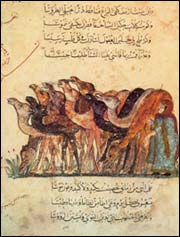

 وسع خيالك