تكتسب الكلمة قداسة غير عادية في خطابيين أساسيين: الخطاب الدينى، والخطاب العاطفي. تتحول الكلمة إلي وعود والتزامات ومواثيق حينما يتعلق الأمر بالحب. يردد الحبيب في كل مرة كلمات مثل “وحشتنى”، “بحبك”. كتعويذة سحرية أبدية. بلا ملل، بلا كلل، ولا تفقد تأثيرها إلا بانتهاء أجل العلاقة، وإذا حدث وفقدت تأثيرها فيكون رد الطرف الأخر: “لا أنت لا تحبني”. في جملة لا تنفي تأثير الكلمة وإنما تنفي دلالتها وصدقها.
الحب شيء خطير يا سادة. هناك قتلى وصرعى ومصابون بسبب الحب. يحدث هذا قديماً ولا يزال مستمراً في الحدوث. صفحات الحوادث في الجرائد تشهد حتي الآن كيف يكون الحب بكل الدراما المحيطة به عنصراً غالباً في كل الجرائم التي تًُرتكب، إن كان بفعل الغيرة أو الشك، أو حتى العنف الناجم عن رفض الحب.
احتياج غريب وجنوني
يحتاج الحب إلي إلى الكلمة: احتياج غريب وجنونى. لنتخيل هذا السيناريو على سبيل المثال؛ يلتقي اثنان في بيئة عمل أو دراسة أو عبر أصدقاء مشتركين، يستحسن كل طرف الآخر، يتبادلان النظرات، الكلمات. يكتشفان اهتمامات مشتركة وتبدأ عملية تأويل كل الإشارات البسيطة والتافهة بشكل قدري. يصرخ طرف مندهشاً “يا إلهى أنت برج القوس، وأنا برج الدلو. أجمل برجين معاً”.
يمكن أن تستمر فترة الأحاديث الودية هذه طويلاً. وفي حلقات اجتماعية آخري يمكن أن تتحول لنزهات لاحتساء المشروبات الكحولية أو تناول العشاء، بل ويمكن أن يتورط الطرفان في إقامة علاقة حميمية. لكن مادام كلا الطرفين خلال هذه المسيرة لم ينطق أحدهما بالكلمة المقدسة فلا التزامات ولا قواعد. أعني يمكن أن يلوم أحد الطرفين الطرف الآخر على تصرف ما، فيرد الملام “لكني لم أفعل شيئاً، لم أعدك بشيء”.
حديقة خضراء صغيرة. تصوير: أحمد
بعد الجنس، قد يجلس الطرفان عاريين في السرير، أو بعد نوبة من الضحكات في المطعم قد يصمت الاثنان وينظران في عينيّ بعضهما البعض. ثم يقول أحدهما “وبعدين؟” يشعر الطرف الآخر بحاجة للرد وتقديم وعود واقتراحات. ثم يتغير كل شيء ما أن ينطق أحدهما بالكلمة المنتظرة “أحبك”. تأتي الكلمة كتأكيد لما يحدث بالفعل بأن الحب موجود، وكاعتراف بالاستسلام لهذا الشعور، بالخضوع لقوة وأثر هذا الحب. حتى الآن كل شيء بديع، لكنه ليس كافٍ.
البحث عن بر الأمان
يبحث العاشق عن ضمانات. الكل يرغب في الحب لكن يريده حباً آمناً. بالتالي، فكلمة “أحبك” ليست اعترافاً، بل وعداً يليها تأكيدات وبراهين. من الطرائف المرتبطة بهذه العملية أنه حينما يعترف طرفان لبعضهما البعض بالحب، لا يقولان للأصدقاء أنهما عشاق أو أحباب، بل يقول “أنا وفلان مع بعض” أو “في علاقة” أو “صاحبتي”. وليس الأمر مجرد خجل من التصريح بالحب بل بحثاً عن نمط مقبول اجتماعياً للعلاقة.
غرقت في بحر صغير من الحب ذات مرة، لكن لأسباب يطول شرحها لم نكن نرغب في تحويلها لعلاقة، ولا حتى وضع هذه التصنيف السخيف الذي يمنحه الفيسبوك “Open relationship”.
في المقابل، وحينما كنا نسأل ما الذي نفعله معاً كان الجواب “عشاق”. وكان الرد الذي نتلقاه: “يعنى أنتم مع بعض”. بدت الضغوط الخارجية علينا أقوى حتى من اختياراتنا لنمط العلاقة. في الحفلات لم نكن نفضّل أن نلتصق ببعضنا البعض رغم أننا نذهب معاً، ولم يكن لدينا إلتزام حصري اتجاه بعضنا البعض بل لكل طرف الحرية في ممارسة أي شيء مع أي شخص، سواء أكان هذا الشيء ممارسة الجنس أو الوقوع في الحب.
تعليقاً على النقطة الآخرى لم أفهم أبداً كيف يجري تأطير الحب ضمن معنى واحد بدرجة واحدة بشكل حصري، ولماذا يتم انكار تعدد إمكانية الوقوع في الحب أكثر من مرة، بل وفي ذات التوقيت، لكن هذا موضوع لتدوينة أخري.
أقول أن البحث عن ضمانات للحب، والضغوط الاجتماعية على العاشقين تدفعهما لتغطيس هذا الحب تحت السطح. والقفز فوق الكثير من الاعتبارات وتحويله لعلاقة. تتطلب العلاقة قدراً من الحب، لكن الحب لا يحتاج إلى علاقة بل يحتاج إلي الإيهام والاستهام وأحياناً وجود الآخر. ثم تأتى القفزة الأخطر كأن يري العاشقان أن الحب مؤهل لتأسيس أسرة.
تحت الضغط الاجتماعى للنظام المعاصر يندفعان لتحويل هذه الطاقة الكبرى “الحب” إلي صيغة إنتاجية في هيئة بيت وأسرة، دون أن يكون هناك ما يمكن أن يضيفه الطرفان لبعضهما البعض، ودون أن تتوافر لديهما أحياناً مهارات العيش المشترك التي تتطلب نوعاً من الحب يختلف عن الغرام أو نشوة الحب الحر. ربما لهذه الأسباب ولأسباب آخرى انتهت قصص حب عظيمة بعلاقات زوجية بائسة، وأحياناً نهايات حزينة.
بقدر قوة الحب وكثافته تكون خيبة الأمل حينما تفشل تجربة العيش المشترك أو بناء الفعل المشترك الناتج عن الزواج. كل هذا بسبب الاندفاع في نطق الكلمات دون إعطاء الفرصة للصمت ولمتعة استحلاب المشاعر أو نموها لتقود الطرفين نحو آفاق أخرى، ما بعد نشوة الحب الأولى، الأبواب المتعددة لاستكشاف الحياة خارج الحواجز التي يضعها النظام والضوابط الاجتماعية التي وجدت لحصار الحب بالكلمات والتعريفات والوعود.
On my first day in prison, trying to make me feel better, my fellow inmates listed the advantages of our particular prison, and our particular ward: most of the inmates were senior civil servants, businessmen, judges, police and army officers. Each ward can take sixty prisoners and the prison has nine wards. ‘We’re all respectable people,’ my colleague said, ‘and the administration here is respectable too.’ I said nothing. ‘And even Alaa Seif is here,’ he said, ‘in the ward across the corridor.’
After years apart, Alaa and I were neighbours again. In 2006 I lived on Faysal Road, two streets away from him and his wife, Manal. Their house was a base for artists passing through Egypt, programmers, adventurers, bloggers and political activists. I used to visit all the time. A friendship grew that opened many doors for me. But eventually I left Faysal Road and Alaa left the country.
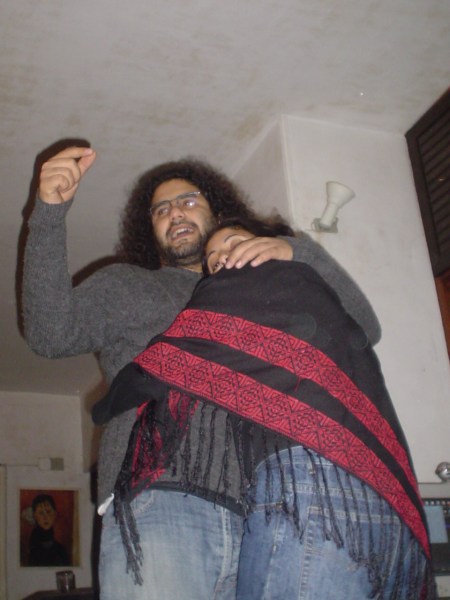
Alaa & Manla @ 2016
On my second day in prison, a colleague came in carrying a white bag. He put it on my bunk and whispered: ‘This bag’s from Alaa … and if you need anything, tell me.’ In the bag were a white T-shirt, a carton of Cleopatra cigarettes (prison currency) and other essentials.
On my third day, I stood in front of Alaa’s door and called out to him. The ‘canaries’ who inform on their fellow prisoners stood around puzzled, listening to Alaa and me trade jokes and insults through the door. He told me there was a library in the prison and the books there were reasonable; I could depend on it for the thirty days till my first visit, when I’d presumably get some books. ‘There are also some novels by Bahaa Taher,’ he said, ‘but I can’t take that nation-state rubbish any more.’
Suddenly the air rang with whistles. Guards, in uniform and plainclothes, rushed at me and pulled me away from the ward door, yelling that it was ‘forbidden’. Thirty minutes later I was taken to the duty officer and told that what had happened was forbidden and any communication between me and Alaa was forbidden.
Five months passed like this: only a wall between us, but we weren’t allowed to talk or exchange messages. The prison schedule was changed so we couldn’t bump into each other by accident. My family once waited outside for five hours so that Alaa and I wouldn’t have our visits at the same time. I never understood what was behind this. In prison it’s no use trying to understand.
One morning, all the men in my ward were asked to collect our belongings and move to Alaa’s ward. I stood in the middle of the room till one of the guards came and said that mine would be the bunk above Alaa’s; these were instructions from ‘high up’.
At first Alaa and I went back to our old quarrels, shouting at each other because he’d accepted the Constitutional Amendments in 2011. After a while we found better topics to talk about in Scientific American and Wired, which came in for an American colleague.
We knew there were canaries dedicated to us, listening out for our conversations, our plots, our plans for a takeover. At odd moments I felt sorry for them. Alaa and I once spent a whole day talking about the future of manual labour and craftsmanship in the age of three-dimensional printing.
Since my release I’ve faced the question in many forms: ‘How’s Alaa?’And though I lived with him for five months, each time it takes me some hesitant seconds before I give the answer I always give: ‘He’s … resisting.’
I think of his anxiety, how he couldn’t sleep as the date for the decision of the Constitutional Court on the Protest Law approached. He had a lot of hope. Hope is the daily torment of the prisoner. If hope gets hold of you in prison there’s no sleep, no food, no comfort.
I think of his disappointment when the judgment was issued. The disappointment after each visit when they told him that the Court of Cassation had not yet set a date to hear his final appeal – even though others in the same case had been given court dates, and some had even had their verdicts overturned.
In our last four months together, exercise was banned throughout the prison. No one was allowed to leave their ward or see the sun. I gave in to my fate. But Alaa put his headphones in his ears and paced the ward for hours each night. At half past two every morning, there was an hour of BBC news on the radio. It was our main source of information. Alaa would listen, then come and tell me what he’d heard. Then we would read the state-sanctioned newspapers and talk, trying to find material for comedy, something to resist with.
I miss Alaa now more than ever. I don’t know if our next meeting will be outside, or if I’ll be going back to him. Sometimes, as I read alone at night, I think I hear the fall of his footsteps.
Our family has a long history of disposing of books in various ways. As a boy in Egypt, I remember the regular routine when, every so often, my father would open the cupboards and drawers and arrange his books, magazines, and notebooks. Most dear to him were the notebooks which contained his commentary and notes on dozens of books, most of them concerning Sufism, Islamic exigency, and political Islam, in addition to the writings of Sayyid Qutb, Hassan al-Banna, and various other Islamist leaders.
He arranged the books into bundles and then distributed them in various secret hiding places. Some were concealed in boxes on the roof next to the chicken coop. Others were left in the care of close relatives who did not take part in any political activities. Other books, the presence of which he believed jeopardized his and his family’s security, were burned. Assured he could attain other copies, these books would be thoroughly burned and their ashes discretely disposed of.
As a boy I did not take notice of this practice nor did I understand it, yet the ritual of collecting books and papers and setting them ablaze on the roof was seared into my memory forever. When I would ask my mother about it, she would fumble for the right words to explain to her child the politics at play, saying: “These books contain verses from the Qur’an and passages of our Lord and cannot be dumped in the waste, so it is best they are burned.”
جرافيى لكيزر 2013 تصوير: أحمد
My grandfather, who had been a security guard at a local factory, also had a huge library to his name. My father told me that there had been a time when my grandfather could not afford to buy a bed, so he piled together astronomy textbooks and poems of Ahmed Shawki—which he had memorized by heart—and made beds of them for his children sleep to on. However in the beginning of the 1980s, he slipped into a depression and gave away most of the contents of his library. Thereafter he contented himself with reading newspapers, poems of Al-Maʿarri, and books on astronomy. The latter of these was his greatest passion, and was what prompted him to name his eldest son Galileo. Yet after some convincing and admonishing based on the pretense that this was an un-Islamic name, he settled for Nagy, contenting himself by writing “Nagy Galileo” in huge letters on the wall of the house.
Unlike his own father, my father did not dispose of his books because of a sudden depression or deterioration in his capacity to read. Rather he did this so because these books could be used as evidence against him in the event he was arrested, and the house was raided. Directives to dispose of these books came down from senior Brotherhood leaders to protect its members. The letters of al-Banna or of Al-Manhaj Al-Haraki Lissira Al-Nabawiya could have been used as irrefutable evidence that my father was a member of a ‘banned organization.’
Thus during slow summer nights in Mansoura, back from our stays in Kuwait, there was nothing to do but read the books of Anis Mansour and Khalid Muhammad Khalid and the plays of Tawfiq al-Hakim. If ever state security forces were to have raided our home and found these books, they would in no way incriminate my father, and thus they were spared from being used as kindling in his ritual campfires. I personally had no need for al-Banna’s writings in order to understand the world of the Muslim Brotherhood, for I lived and breathed it every day of my life.
In Kuwait, just as in Egypt and more than a hundred other countries, the Muslim Brotherhood runs a social welfare network which not only provides for individuals, but entire families. I would attend weekly sessions with other boys who themselves were also from Egyptian families with ties to the Muslim Brotherhood residing in Kuwait.
At that time, the usual program for children my age, aside from reading the Qur’an and becoming acquainted with the Prophetic biography, consisted of regular recreational activities organized over weekends. As a boy suddenly transported from a village on the outskirts of Mansoura to a new environment such as Kuwait, these outings with the Brotherhood youth (or ‘cubs’ as they are known) were filled with adventure and new experiences that helped allay any feelings of homesickness.
Life in Egypt moved to a slightly different rhythm. In our village I was regarded as somewhat special because of my father’s prominent position as a doctor in the Brotherhood. He was a role model for many of the other ‘cubs’, something of which I had not been aware.
Reserved and taciturn by nature, my father spoke little of his past and never spoke at all about anything regarding the Muslim Brotherhood.
He recently told me of his colleagues’ surprise at the hospital, at which he has worked for the past eight years, when they learned only a few months ago that he is a Brother. They only became aware of this after he began attending Doctors Syndicate meetings as one of the Brotherhood’s representative.
My mother was never comfortable with the “Sisters” and felt no urge to take part in Brotherhood activities. Before the revolution, some members of the Brotherhood leadership would coincidentally appear on the news, and she would utter a brief comment, such as, “He was a good friend of your father. They would come to visit and have dinner at your grandmother’s.”
The first thing Brothers in Mansoura and in our village would say upon meeting me was always, “So you are the son of Dr. Nagy Hegazy. You must be proud, God is good!”
Both in Kuwait and Egypt, I always attended private schools, the names of which always included the all-important words ‘Islamic’ and ‘Languages.’
The Guidance and Light School, in which I spent my third year of preparatory school after our return from Kuwait, was a Brotherhood school which my father helped establish. Since the 1980s, schooling and educational services had become a key aspect of Brotherhood activities and a means of proselytizing. We followed the same curriculum as the public schools, except that we took two additional courses twice per week; one was entitled ‘The Holy Quran’ and the other was a mixture of Islamic stories and proverbs. The only other change was that Music class was replaced with another class titled ‘Hymns.’
Except for drums and tambourines, musical instruments were banned and discouraged. Flyers and posters hung on the school’s walls warning about the dangers of listening to stringed instruments. The hymns which we were forced to memorize consisted of the most widely known nationalist melodies and songs except any mentions of ‘Egypt’ were replaced with ‘Islam.’ The school was of course populated with the children of local Muslim Brotherhood leaders in addition to other Muslim students of diverse backgrounds.
Only now do I realize that until the age of fourteen, I had never once met a Christian. I was in an exclusive world with its own moral values, worldviews, and perspectives on what it meant to be a good person.
Transitioning from the sheltered Brotherhood schools to the Taha Hussein Public High School was tantamount to setting foot on another planet. For the first time there were Christians in school, and the library contained books other than the standard morning and evening Islamic prayers.
The utopia free of insults and cursing in which Brothers moved about nibbling on siwak1 and smiling warmly seemed far away. With the second intifada I became more active, and despite the fact that I was still in high school, I would attend meetings with the Brothers at university. I crafted the chants which were shouted in unison during the demonstrations following the killing of Muhammad al-Durrah. I had become an integral member of the Brotherhood group at al-Azhar University. Then Haidar Haidar happened.
A Brother brought several copies of the newspaper Elshaab and placed them beside him. Like any other meeting, that day’s session began with one Brother reciting from the Holy Quran, followed by a second interpreting a hadith, and a third explaining an aspect of Islamic jurisprudence. Then the Brother opened the newspaper and read it aloud to the group.
He read that the Egyptian Ministry of Culture had published a novel by the Syrian writer Haidar Haidar. Aside from sexual references, the novel contained heretical insults directed at God and the Prophet Muhammad (Peace be upon him). In response, preparations for public rallies were made which would protest the publication of the novel and demand it be burned.
Word for word, this is what the Brother demanded, and I instantly objected. At that time I was the group’s writer, and I refused to write any chants which called for the burning of this book or any other book for that matter.
To this day, I do not know what compelled me to take this firm stance.
I showed one of them some excerpts from Haidar Haidar’s novel which were published in Elsh aab. From what I read, I found his writings ridiculous, but I insisted that this in no way justified it being burned. I entered into a long discussion with the Brothers which developed into shouting. The argument between me and the group’s leader grew increasingly sharp, and in an angry outburst he forbade me from taking such a stance. The argument grew even more hostile, and he told me, “Either give up these books you read and your stance on them, or do not meet with us!”
I left the room, and never went back.
—- —
1 A small twig (the tip of which is softened by chewing) from the Salvadora persica tree used for cleaning teeth. It is widely held that the Prophet Mohammed recommended its use.
I first heard the name Ahmed Naji at a PEN dinner last spring. I looked up from my dessert to a large projection of a young Egyptian man, rather handsome, slightly louche-looking, with a Burt Reynolds moustache, wearing a Nehru shirt in a dandyish print and the half smile of someone both amusing and easily amused. I learned that he was just thirty and had written a novel called Using Life for which he is currently serving a two-year prison sentence. I thought: good title. A facile thought to have at such a moment but it’s what came to mind. I liked the echo of Georges Perec’s Life: A User’s Manual—the coolness of that—and thought I recognized, in Naji’s author photo, something antic and wild, not unlike what you see when you look at pictures of Perec. You could call it judging a book by its cover: I’d rather think of it as the readerly premonition that this book might please me. If he had written a book called Peacocks in Moonlight and posed for one of these author portraits where the writer’s head is resting on his own closed fist, I would have been equally shocked and saddened to hear he was in prison, but perhaps not as keen to read it.
As I was having these unserious thoughts the contents of the novel were being roughly outlined for us all from the stage. It sounded intriguing: a kind of hybrid, with certain chapters illustrated as in a graphic novel, and with a comic plot concerning a dystopian Cairo, although it was in fact the novel’s sexual content that had landed its author in jail. Though the novel had been approved by the Egyptian censorship board, a sixty-five-year-old “concerned citizen,” upon reading an excerpt in the literary weekly Akhbar al-Adab, had felt so offended by it that he made a complaint to the local judiciary, who then charged Naji and the editor of the weekly with the crime of “infringing public decency.” (The editor is not serving a jail sentence but had to pay a fine.) There was, to me, something monstrous but also darkly comic about this vision of a reader who could not only dislike your prose but imprison you for it, although of course at the dinner the emphasis was necessarily on the monstrous rather then the ludicrous. But when I got home that night I found an online interview with Naji in which the absurdity of his situation was not at all lost on him:
I really enjoyed the dramatic statement of that plaintiff reader. He told the prosecution that he buys the journal regularly for his daughters, but that one time, his wife walked into the room showing him my published chapter and ridiculing him for bringing such writing into their home. He said his “heartbeat fluctuated and blood pressure dropped” while reading the chapter.
Naji seemed bleakly amused, too, by the months of semantic debate that had led to his prosecution, in which the judges sophistically tried to separate fiction from a non-fiction “essay,” determining finally that this extract was in fact the latter, and so subject to prosecution as a kind of personal revelation:
According to their investigations and official documents, my fiction registers as a confession to having had sex with Mrs. Milaqa (one of the characters in my novel), from kissing her knees all the way to taking off the condom. They also object to my use of words such as “pussy, cock, licking, sucking” and the scenes of hashish smoking. Ironically, this chapter speaks of the happy days of Cairo, as opposed to the days of loss and siege dominant in the remaining chapters. This specific chapter is an attempt to describe what a happy day would look like for a young man in Cairo, but perhaps a happy life feels too provoking for the public prosecutor!
Which sounded even more intriguing. A few days later I’d managed to contact Naji’s friend and sometime translator Mona Kareem, who sent me a PDF of Using Life (itself translated by Ben Koerber) to read on my Kindle. It opened with a beautiful line of Lucretius, and I felt immediately justified in my superficial sense of kinship: “Forever is one thing born from another; life is given to none to own, but to all to use.” And as I read on, the novel’s title took on a different resonance again, for here was a writer not content to use only one or two elements of life, no, here was a guy who wanted to use all of it:
In September, as the city’s residents were just beginning to recover from the most traumatic summer of their lives, there came a series of tremors and earthquakes that would be known as “The Great Quake.” It resulted in the destruction of nearly half the city. The there was an eruption of sinkholes that swallowed entire streets, and distorted the flow of the Nile…The sinkholes did not spare even the pyramids, and nothing could be done for the Great Pyramid itself, which was reduced to a simple pile of rubble. All that was left of our great heritage—our civilization, our architecture, our poetry and prose—would soon meet a fate even worse than that of the pyramids. Everything collapsed into the earth or was buried under oceans of sand.
So here was the epic mode—the fantastical analogy for a present political misery—but right up next to it, unexpectedly, was the intimate, the bathetic, the comic:
[She] went back to rolling the joint, twisting one end into a little hat. She took out her lighter and set the little hat on fire. Watching the slow, dark burn gave me a tingle on my cock, which I put out with a scratch.
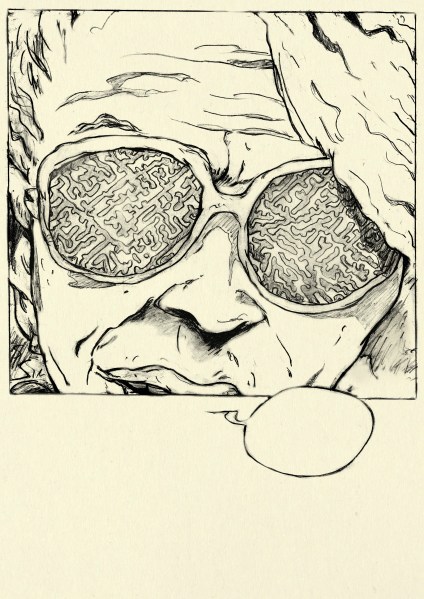
Aymen Drawings in Using life
The girl in question is Mona May and she’s impossible. The narrator is a young man in a failing state but he is also just a kid in love with a (slightly older) woman who happens to drive him up the wall: “I looked at my face in the mirror, and asked myself a serious question: what am I doing here? If I could put up with her arrogance, her stupidity, her hallucinations, her mid-life crisis…what should I expect in return? At the very least, if I loved her, was still obsessed with her, then there was no reason for me to be here, since my presence clearly causes some kind of disturbance in her world.” Angst! Romance! Sex! Dicks! And illustrations, though these I could not see in the PDF, and had to content myself instead with the tantalizing captions. (“The leftover particles of shit that stuck to our bodies resulted in certain deformities. Marital relations suffered, and many died.”) Using Life is a riotous novel about a failing state, a corrupt city, a hypocritical authority, but it is also about tequila shots and getting laid and smoking weed with your infuriating girlfriend and debating whether rock music died in the Seventies and if Quentin Tarantino is a genius or a fraud. It’s a young man’s book. A young man whose youth is colliding with a dark moment in history.
In an attempt to draw more attention to Naji’s cause, Mona recently translated three very short, flash-fiction type stories for PEN’s website. They published one, “The Plant,” which begins like this:
I will not come through the door or the window,
but as a plant you cannot notice with your naked eye.
I will grow day after day, to the sound of your singing and the rhythm of your breath at night. A small plant you will not notice at first, growing beneath your bed.
From door to bed, to bathroom to closet, standing or sitting against the mirror. Through all these acts, and to the sound of your humming, I will grow. A small green plant. With grand slim leaves sneaking out from beneath your bed.
I read this voice first as the spirit of underground resistance, then as the essence of pervasive dictatorship, and then back to resistance once more. The second story, unpublished, was called “Ambulance” and began like so: “She was sucking my dick when suddenly she stopped to ask if I had given grandmother her medicine.” The last, also unpublished, was called “Normal,” and it opened this way: “One time as I was heading back to Sixth of October city, a prostitute showed up on the way dressed in the official uniform, a black cloak without a headscarf, and instead she had bangs and black hair falling over her shoulders. She was carrying a huge neon bag.”
Mona seemed a little perplexed that PEN had chosen only one of these shorts, but I could understand it. An imprisoned writer is a very serious thing indeed and should not be treated lightly, so it puts an activist in a certain sort of bind when the writer in question turns out to be lightness itself. Naji’s prose explicitly confronts what happens when one’s fundamentally unserious, oversexed youth dovetails with an authoritarian, utterly self-serious regime that is in the process of tearing itself apart. It’s very bad historical luck—of the kind I’ve never suffered. It’s monstrous. It’s ludicrous.
But the fact that the punishment does not fit the crime—that prison is, at this moment in Cairo, the absurd response to the word “pussy”—is exactly what shouldn’t be elided. In another historical moment, or so it occurs to me, young Ahmed would be at that PEN dinner, sitting right next to me, having come over from Cairo for a quick jaunt to see writer friends in Bed-Stuy, and he’d be a bit bored by the solemn speeches, sneaking out the back of the museum to smoke a joint perhaps, and then returning to his seat in high humor just in time to watch a literary giant whom he didn’t really respect come up to the stage to receive an award. That, anyway, is the spirit I detect in his novel: perverse and brilliant, full of youth, energy, light! Some writers, in the face of state oppression, will write like Solzhenitsyn. Others, like Naji, find their kindred spirits in the likes of Nabokov and Milan Kundera, writers who maintained their instinct for unbearable lightness and pleasure, for sex and romance, for perversity and delight, in the face of so much po-faced violent philistinism.
“I think I understand now,” writes Naji, in Using Life, “that the bullshit inside of us is nothing but a reflection of the bullshit outside. Or maybe it’s the other way round. In either case, the outside bullshit eventually seeps inside, and settles into the depths of our souls.” But on the evidence of his own writing the bullshit has not yet settled in Naji, not even in his jail cell. He is part of a great creative renaissance in Cairo, of young novelists and poets, graphic novelists, and—perhaps most visibly—graffiti artists, who have turned the city’s ever increasing walls into a staging site for political protest and artistic expression. Since 2014, President Sisi has cracked down on this community, with new restrictions on the press and multiplying arrests of artists and writers, and yet the Egyptian constitution guarantees both artistic freedom and freedom of expression. Naji has been prosecuted instead on Article 178 of the Penal Code, which criminalizes “content that violates public morals.”
An attempt to appeal was rejected in February. Naji’s last appeal is on December 4. If you read this and feel so moved, tweet #FreeNaji and any other social media action that occurs to you. Hundreds of Egyptian artists and intellectuals have signed a petition in support of Naji but there are also loud voices who feel that his example should not be used in a “freedom of literature” argument because they see his writing as not really literature, as fundamentally unserious. Using Life is certainly comic, sexual, wild—the work of an outrageous young man. We should defend his freedom to be so. “Falling in love in Cairo,” I learn, from his novel, “You have to prepare for the worst. You just can’t walk over to her and say, ‘Mona May, I’ve got the jones for you.’ Words like these could get a man hurt.” Over here, in New York, words won’t get you into too much trouble—not yet, anyway. What would we dare to write if they did?
Editor’s note: Ahmed Naji was released from prison on December 22, after Egypt’s highest appeals court temporarily suspended his sentence; a hearing will be held on January 1 to determine whether he will face another trial or be sent back to prison.
Ahmed Naji’s novel Using Life, in an English translation by Ben Koerber, will be published by The Center for Middle Eastern Studies (CMES) at The University of Texas at Austin next year.
يطيب لى أن أوضح ونؤكد مرة آخري أنى خرجت من السجن بقرار إخلاء سبيل من محكمة النقض على ذمة القضية. وأن القضية لا تزال منظورة أمام محكمة النقض التى حدد لها جلسة 2 أبريل (الأحد القادم)، وأنا لا أزال متهم على ذمة القضية وممنوع من السفر. الحضور في محكمة النقض للمحامين فقط. لكن دعمكم وحبكم بكل الأشكال حتى لو بالصمت العاجز هو أكثر ما نحتاجه وهو ما يؤكد على حقنا (طبقاً لما أقره دستور 2014) في الخيال والكلام.
الأحد القادم من المتوقع أن تصدر محكمة النقض قرارها. شخصياً مع فريق المحامين نطمح في البراءة أو إحالة المسألة للمحكمة الدستورية للبت في مدى دستورية المادة 187 التى تجيز حبس الكتاب والمبدعين بما يخالف المواد الصريحة في الدستور التى تكفل حرية الرأى والتعبير. لكن وكما علمتنا تجربة العام الماضي فالأحلام الكبيرة قد تنتهى بكوابيس أكبر أيضاً. لذلك فاحتمالية تأييد الحكم السابق، أو الحكم بالإدانة مع تخفيف العقوبة كلها أيضاً احتمالات مفتوحة.
في كل الأحوال ومهما كانت نتيجة ما سيحدث يوم الأحد القادم. أحب أن أتوجه بالشكر لكل أعضاء فريق الدفاع الأساتذة نجاد البرعى، ناصر أمين، خالد على، ياسمين حسام الدين، محمود عثمان وفريق مؤسسة حرية الفكر والتعبير. تحملوا معنا على مدار الشهور الماضية الكثير من الاجراءات والخطوات القانونية المعقدة. ومنحونى متطوعين من الدعم والمحبة ما لا أعرف وسيلة مناسبة لرده.
الشكر أيضاً لكل من دعمنا في القضية بكل شكل، حتى لو كان ذلك باستيتوس أو تغريده. ففي الليل الحالك حينما يرتفع الموج مجرد سماع أصوات أخري يجعلنا نتأكد أننا لسنا لوحدنا في تلك اللجة وأن هناك أيادى ممدوة لنا يمكن أن نعتمد عليها. وليقضي الله أمراً كنت تحسبه بسوء ظنك مستحيلا، ولكن عنده سهلاً يسيراً، وإن كنتم تألمون فإنهم يألمون كما تألمون وترجون من الله ما لا يرجون
voأحدهم نصب لى فخاً! في الأفلام والمعالجات الدرامية والروائية، وحتى في النبرة التي يحكي فيها الذكور متفاخرين بتجاربهم العاطفية، يرد الانفصال أو الطلاق كوصمة عار ونقطة حزن في حياة المرأة، ولحظة قوة وحزم في حياة الراجل… وقد وقعت في الفخ.
سواء أكانت المقدمات للطلاق أو الانفصال من سفاسف الأمور التي تتراكم ببطء وصبر حتى لحظة انفجار تدمّر السد، أو جلمود صخر يسقط فجأة فيولّد معركة تتنهى بنهايات درامية… مهما كانت المسببات أو النتائج، أو عدد المحاولات المتوالية لإصلاح ما انكسر، أو البحث عن مخرج للحفرة، هناك نقطة يصل الظلام فيها إلي أقصى درجاته: نقطة تتوهم أن الطلاق أو الانفصال هو بصيص النور الذي يمكنك أن تهرب عبره من سواد الظلمة إلي شمس البدايات الجديدة. هذا أيضاً فخ.
بينما تستسلم إلى حل نهاية الطلاق وتسير نحوه، تجد المسائل تتعقد أكثر. العائلة تبدأ في التدخل. وفي الغالب هذا أسوأ ما يمكن أن يحصل. فأولاً سيطالبون بالحق في معرفة كل التفاصيل والمبررات للطلاق، وتحت ضغطهم و”الزن على الودان” المتواصل سرعان ما ستستسلم وتخبرهم بالتفاصيل. وحتى إذا التزمت الصمت، وتمسكت باحترام خصوصية العلاقة، في اللحظة التي سيعترف فيها الطرف الآخر لعائلته ستندفع أنت في حماقة أخرى لتعترف بدورك لعائلتك. حينها ستتضاعف المشاكل وتتصاعد الدراما.
تصوير: أحمد
سينفجر الأمر
الخطأ الثاني الذي وقعت فيه وغالباً ما يتكرر في العائلات العربية أن تقرر تحت دافع السأم واليأس ترك مناقشة التفاصيل المادية للانفصال وتوكيل العائلة بتولي الإجراءات القانوينة والبيروقراطية، أو أن تفقد أعصابك في أي لحظة من لحظات التفاوض. سينفجر الأمر، ومع العائلات سيتدخل المحامون، ليبدأ فصل آخر مساره المحاكم والقضاء الشامخ، ورشاوى للأمناء، وبلطجة وقلة أدب وقيمة في بلد لا تعرف من القضاء إلا شموخه.
شاهدت رجالاً ينهارون تماماً مع دخول المسائل في مرحلة المحاكم. يتحولون إلى مضطربين بردود أفعال عنيفة تجاه كل شيء، بل يصبح من الصعب التنبؤ بأفعالهم. لم أدرك الداعي والسبب إلا حينما مررت بذات الموقف. كان هناك بركان من المشاعر الجديدة كل يوم تخرج إلى الملأ لأول مرة. نعيش كذكور خلف قواعد وأقنعة تحدد لنا ما هي الرجولة، وما هي صفاتها، وكيف ينبغي أن نتحرك ونتفاعل كي نكون “ذكراً”، وكل هذا من أجل جذب الطرف الآخر. لكن حينما يتبدد الحلم، ونقترب من فقدان الطرف الآخر، تنهار أقنعة الرجولة ونرى أنفسنا في مواجهة فيض من المشاعر المختلطة والمتضاربة، والتي لم يخبرنا أحد كيف يجب أن نتفاعل معها. في المقابل، تمر حالة من السكينة والهدوء والثقة والقوة الغريبة على كل امرأة عرفتها مرت بمرحلة الطلاق والانفصال. قد تصاب بالحزن والإحباط، وربما حالة عدمية ولا مبالة، لكن تظل مسارات المشاعر ذات كينونة معروفة وهي الحزن والاكتئاب. أما الرجل، فبسقوط القناع، يسقط في “حيص وبيص”، وتضارب واندفاع جنوني من أقصي اليمين إلي أقصي اليسار.
تجاوزتُ إجراءات الطلاق والانفصال بهدوء وسكينة وقدر من الاحترام والود. لكن ما بعد الانفصال: هذا الفراغ لم أعرف كيف أواجهه!. ظننت لفترة أنني حالة خاصة، مميز ومختلف، لكني سرعان ما وجدت أن قصتى متكررة. صديق طيار حربي جاء منهاراً بعد الطلاق يحكي كيف أنه، ولأول مرة، شعر بالتشتت حينما خرج في مهمة.
إذا اتجهت للخارج ستجد أن الهوة تتسع أكثر فأكثر
دورة مؤسفة. ففي الزواج اندفعت في دوامة العمل حتى تركت العلاقة تغرق في بحر من الرمال، وحينما انفجرت المشاكل، بدا الطلاق كوسيلة للتخلص من المشاكل والتفرغ للعمل. لكن بعد الطلاق، لم تعد هناك حاجة للعمل، وفكرة الادخار أو الاستقرار المادي تضاءلت. تحاول أحياناً تعويض الفراغ بالانطلاق في رحلات استشكافية جديدة، لكن إذا اتجهت للخارج ستجد أن الهوة تتسع أكثر فأكثر. ذلك أن ما لا تبحث عنه، وإن كنت تحتاجه، سيكون بالداخل وهى رحلة أكثر وعورة. لا تتوقع أبداً أن تجد ما فقدته، أو تجد أي شيء عموماً. فالمهم هو ما ستتركه الرحلة من آثار عليك. حينها ستتغير أنت وستجد أن ما تبحث عنه قد تغير، وأصبح شيئاً أو أشياء لم تكن لتراها دون العبور من هذا النفق وترك ما ظننته يوماً حياتك، وتعيش ولادة جديدة وإن حملت جينات وتاريخ الحيوات السابقة.
المدونات تعبّر عن رأي صاحبها وليس بالضرورة عن رأي الموقع.
will not come through the door or the window, but as a plant you cannot notice with your naked eye.
I will grow day after day, to the sound of your singing and the rhythm of your breath at night. A small plant you will not notice at first, growing beneath your bed.
From door to bed, to bathroom to closet, standing or sitting against the mirror. Through all these acts, and to the sound of your humming, I will grow. A small green plant. With grand slim leaves sneaking out from beneath your bed.
I once read about plants that survive on light and prey on other creatures. With their glowing green leaves, they surround them and lure them in with a pleasing, lustful smell, then devour them. For hours and days and years, sucking on them. Sucking your toes one by one, making my way up.
What should I do with the bee? What should I tell the flower?
You become one with the flower. You grow up. You become a tree. While I remain a plant, in need of your humming, awaiting a song. A part of me is falling every morning, and I cannot catch it. A part of me flies off every time I lie in bed. But when I wake up I cannot remember what.
Sometimes I am reminded to look under the bed. But I don’t find the green plant. Nor do I find you.
كتبت هذه التدوينة مباشر بعد الخروج من السجن، ونشرت لأول مرة على صفحة “وسع خيالك” وصفحة “ضد محاكمة الخيال” بتاريخ 24 ديسمبر 2016
صباح الخير، وورد الوردوش على الجميع..
بعد أكثر من 300 يوم من العزلة عن العالم الخارجي والانترنت الحبيب، يدور المكن ببطء في محاولة لاستيعاب ما يحدث في العالم وإيقاع اللحظة حتى أكون قَادراً على التحدث بما يمكن فهمه، لذلك عذراً على التأخر في الكتابة.
لا أزال في المرَاحل الأولى لاستيعاب ما حدث وكل رسائل الحب والتضامن التى فاقت كل توقعاتى ولم أكن أعلم عنها شيئاً طوال فترة السجن حيث كان يتم حجب هذه الرسائل لذلك لا أزال في صدمة استيعاب كل ما كان يدور بالخارجِ طوال عشرة شهور مضت ومعرفة كل ما فعلتوه. الموضوع مُذهل خصُوصاً بالنسبة لشخص غير اجتمَاعى مثلي، ولا مُثقف تنويري. كل ما حدث وما يحدث من حُبكم يبدو مُفاجأة مُتجددة أحتاج لوقت طويل لاستيعَابها. أدين لكل هذه الرسائل بالطاقةِ والدفء التى كانت أفضل عون للاستمرار والتماسك والقدرة على ممارسة وتجاوز التجربة.
أدرك أيضاً أن الكثير من هذا التضامن ليس لشخصي الضعيف ولا لـ #استخدام_الحياة بل يأتى من أفراد يهمهم أن يكونوا في مُجتمع صحى أكثر بحد أدنى من سقف لحرية الرأى والتعبير. من أخرين لديهم هذا الشغف بالأدب وبالايمان بأخوته العابرة للحدود القومية والأعراق الجنسية. وأنا لم أكن أتخيل أن يكون عدد أفراد الفئات سابقة الذكر بمثل هذا العدد وهذا الاهتمام والحماس للتعبير عن أنفسهم، وعن ما نحب. فشكراً لهؤلاء الذين لا أعرفهم لأنهم فتحوا عينى عل عالم كنت أظنه في هشَاشةِ الزجاج بينما أتضح أنه في قوة الماء.
الشكر بالتأكيد في القلب من كل ذلك لفريق المحامين الأساتذة ناصر أمين، نجاد البرعي، خالد على، ياسمين حسام الدين، محمود عثمان وكل فريق عمل موسسة حرية الفكر والتعبير. إلي جانب كل الأساتذة والزملاء الذين حضروا معانا جلسات الاستشكال المتعددة. أدين للجهد القانونى والصبر وتكاتف جهود الجميع بخروجى الآن وكتابة هذا.
الزملاء الكتاب سواء في مصر أو الدول العربية، على عهد المقاومة والمرواغة وسعيد بأنى جزء من هذه الفيسفَاءالمُتنَاقضة المُتنافرة الشَاردة وسط خرابات الشرق الأوسط الكبير، وفي زمن عودة الانحطاط القومى الغربي مُدججاً بقوة سخَافة الديمقراطية فأخوة الكُتاب مُمتدة ومتمَاسكة، وسعادتى لا توصف برسائل التضامن والمحبة التى وصلتنى بشكل خاص من كتابي المفضلين وبعضهم كانت أعمالهم اللذة الوحيدة المتاحة في السجنِ، والبعض الآخر قرأت لأول مرة له أيضاً داخل السجن.
أما مفاجأة العام فقد كانت هذه التيار من السياسيين والبرلمانيين المصريين الذين أظهروا انحيازهم للدستور أولاً الذي أقسموا عليه، ولتعزيز حرية الرأى والتعبير من خلال تغيير القوانين المعوقة لحرية الرأى والتعبير أو التى توقع عقوبات سَالبة للحرية على النشر أو التعبير الفنى مما يحمل تناقض صريح مع الدستور. صحيح أن جهود هؤلاء لا تزال جزء من عملية الشد والجذب في حلبةِ الصراع اللاسياسي في مصرنا الحنونة. لكن شهدنا زمن يكون فيه البرلمان هو المبَادر بتغيير العقوبات السَالبة للحريةِ في جرائم النشر والعلانية بينما تعترض الحكومة. وهى خطوة أولى على طريق طويل.
بشكل شخصي أوجه الشكر للنواب أحمد سعيد، ود.نادية هنري على مبادرتهم بتقديم مقترح لتغيير العقوبة السالبة للحرية في مادة خدش الحياء بما يتماشي مع الدستور وعلى التكاتف والتأييد الذي أبداه عدد من النواب أبرزهم أعضاء حزب المصريين الأحرار. وخارج البرلمان كان التكاتف والاهتمام من جانب عدد من الأحزاب السياسية دليل آخر أنه حتى وسط وحش التضخم الذي نهوى جميعاً داخل أحشاءه لا نزال قادرين على التفكير في حقوقنا الطبيعية.
أيام السجن بصراصيرها وعرقها وبردها ومهانتها. لم أكن بقادرٍ على تحملها وتخطيها إلا بسبب رفقة الزملاء المساجين، وبشكل خاص زملاء عنبر 4-2 بسجن الزراعة، والسادة البكايتة والدباديب من كل الجنسيات الأفريقية واللاتينية والعربية في عنبر 1-2. وأمنيتى للجميع أن يأتى الغد بتعديل أكثر انسانية لقوانين الحبس الاحتياطى بحيث لا يكون عدد مرتدى الأبيض في السجون أكثر من مرتدى الأزرق.
الزملاء الصحفيين والإعلاميين. شكراً على المتابعة والاهتمام والتغطية. لدي ظروف صحية، والتزامات عائلة تحتل الآن ولأيام قَادمة الجزء الأكبر من وقتى إلي جانب عدم وجودى داخل القاهرة. فقدت خط هاتفي لكن سأحاول الحصول على رقم جديد في أقرب وقت. ليس لدى ما أضيفه أو أرغب في التعليق عليه في الوقت الحالي، والأولوية للالتزامات العائلية الآن، أعتذر عن عدم قدرتى على تلبية أى دعوات لإجراء أى أحاديث أو تصريحات في الوقت الحالي حتى نرفع المكن ونزيت الماتور وأفهم ما الذي يحدث يدور في الكون الذي يدور، شكراً لاهتمامكم وتفهمكم.
الأصدقاء والصحاب والأحباب نفر نفراية وفرد فردايه، في سويداء القلب ومحبة موصولة دائماً وليالينا قادمة وكلام وأحضان كتير في انتظارنا.
أخيراً، لا تزال القضية مفتوحة، ولا تزال هناك جلسة مصيرية يوم الأحد بعد القادم أمام محكمة النقض. تضامنكم وحبكم حتى نتجاوز تلك الخطوة الأخيرة بكل الخير وبسعادة.
في أغسطس 2014، وجد مواطن مصري يدعى هاني صالح توفيق مصادفة العدد رقم 1097 من جريدة أخبار الأدب الأسبوعية. أثناء قراءته لصفحات قسم “إبداع”، قال إنه أصيب باضطراب في ضربات القلب، وانخفاض في ضغط الدم، وتعرض لوعكة صحية شديدة. ذهب توفيق إلى المحكمة وقدم بلاغًا ضد كل من صاحب النص، الروائي والصحفي المصري أحمد ناجي، ورئيس تحرير أخبار الأدب طارق الطاهر لنشره “مقالاً جنسياً” أصابه بأضرار ليست فقط صحية وأخلاقية، ولكنه قال إن المقال يُسيء للأخلاق والآداب العامة.
النص الذي أحدث كل هذا هو فصل من رواية “استخدام الحياة“، أحدث أعمال ناجي (دار التنوير – 2014). وهو يحتوى أوصافًا جنسية صريحة- كما هو الحال مع الكثير من الأعمال الأدبية العربية (انظر كتاب “الحب والجنسانية في الأدب العربي الحديث”، 1994).
في 14 نوفمبر، ذهب ناجي وطاهر ليدافعا عن نفسيهما وعن الرواية أمام محكمة الجنايات. (وسيمثلان مجدداً أمام المحكمة غدا السبت الموافق 12 ديسمبر). يواجه المؤلف ما يصل إلى سنتين من الحبس أو غرامة تصل إلى 10 آلاف جنيه إذا وجد مُذنِباً، إذ تقع التهمة تحت طائلة المادة 187 من قانون العقوبات، والتي تتحدث عن حماية الآداب العامة. الطاهر أيضًا متهم لإهماله مسؤولياته كرئيس تحرير أخبار الأدب، حيث قال للنيابة إنه لم يقرأ الفصل قبل أن يسمح بنشره.
كتب ناجي على حساب فيسبوك الخاص به أن الاتهام الموجه إليه يعد النص المنشور مقالاً، وليس جزءاً من رواية، والتي هي بطبيعة الحال عمل أدبي. لم يُفهَم الفرق بين “الصحافة” (المفترض أنها تستند إلى أحداث حقيقية) و”الرواية” (المعتمدة في الأساس على الخيال). لذا وجدت النيابة أن أفكار بطل الرواية “باسم بهجت” وسلوكياته، المُضِرة بالأخلاق العامة، تعود في الواقع على المؤلف نفسه.
يُسرَد الفصل في الواقع بضمير المتكلم؛ يحكي عن يوم عادي من حياة باسم (23عامًا) في القاهرة، المدينة المُنفِّرة، التي لا تنام، بل يتمدد نشاطها وتنفث بحركة غير عادية. يجد باسم عزاءه وسط أصدقائه، فمعهم يقضي الليل في تدخين الحشيش، شرب الكحول، الاستماع إلى الموسيقى والحديث عن الجنس. تبدو هذه المجموعة من الأصدقاء هي الشيء الوحيد الذي أعطته إياه هذه المدينة. يقضي باسم اليوم التالي في جزيرة الزمالك، الحي الأكثر هدوءًا وخُضرة، مع حبيبته السيدة “ملعقة”، كما يحب أن يدعوها بسبب الأقراط التي ترتديها. تُوصَف بأنها مسيحية مصرية، تعلمت في الخارج وتكبره بتسع سنوات، وقد قررت أن تعيش الباقي من حياتها في مصر، ولكنها لم تعد تُرجِح احتمالية أن تكون هناك علاقة بينها وبين رجال من عمرها. تبدو جزيرة الزمالك والراحة التي يشعر بها في منزل حبيبته ملاذاً في مدينة غير مستقرة. يتوَّج الفصل بوصف مشهدي وشعري لممارستهما الجنسية. وينتهي بباسم محاطًا من جديد بأصدقائه، محدّقين في الغروب من على قمة جبل المقطم.
مُستخدِماً لغة القرن التاسع عشر ومصطلحاته، يصف وكيل النيابة الفصل بأنه “مادة شهوانية” ويتهم ناجي باستخدام عقله وقلمه لـ”أغراض خبيثة تنتهك حرمة الآداب العامة”، متجاهلًا حقيقة أن الرقابة المصرية سمحت بدخول الرواية إلى مصر، عند استيرادها بعدما طبعتها دار التنوير في لبنان.
رواية ناجي ليست الكتاب المصري الأول الذي يذهب إلى المحكمة لنشره أموراً “لاأخلاقية”. ففي 2008، حدثت تجربة مشابهة لذلك مع مجدي الشافعي بعد نشر روايته المصورة “مترو“. وقد غُرِّم المؤلف وناشره خمسة آلاف جنيه، وصودِرت “مترو” ومنعت من النشر حتى قبل سنتين من وقتنا.
****
ولكن أخبار محاكمة ناجي ذكرتني لحظة سماعها بقصة محاكمة المؤلفة اللبنانية “ليلى بعلبكي” عام 1964، وهي موجودة بالكامل في كتاب “نساء شرق أوسطيات يتحدثن” (1977). مثل ناجي، اتهمت بعلبكي بنشرها محتوى جنسياً صريحاً في كتابها “سفينة حنان إلى القمر” (1964). وُجِه إليها السؤال حول عبارتين: “كان يستلقي على مؤخرته، أخذ بيدي ووضعها على صدره، ثم تنقل بيده على بطني، لعق أذنيّ، ثم شفتيّ، أحاط جسده بي كلياً، استلقى فوقي وهمس وهو في نشوة أنني نضرة، ناعمة لدرجة خطيرة. وأنه لهذا، افتقدني كثيرًا.”
مثل حالة ناجي، كانت رواية بعلبكي قد نشرت قبل ذلك بتسعة أشهر، بعد أن حصلت على تصريح قانوني بطبعها ونشرها. وقد صودر الكتاب بعد هذا الاتهام (لا تزال رواية ناجي متاحة في المكتبات).
بعد ما يزيد عن 50 عام، يبدو تقرير محاكمة بعلبكي مكتوباً بلغة قانونية جافة، ولكنه ما زال يعطينا إشارات ويسلط الضوء على بعض المسائل الهامة المتعلقة بالأدب كممارسة، ومعنى الكتابة الروائية والرقابة. يُظهِر التقرير بعض النقاط التي يجب أن يشار إليها في الدفاع عن ناجي ككاتب، وفي الدفاع عن الأدب والإبداع عمومًا.
محامي الدفاع الخاص ببعلبكي، الذي أُشير إليه فقط بـ”سالم”، حصل على خطاب دعم من لجنة مفكرين لبنانيين معروفين، والذين طُلِب منهم قراءة الرواية وباقي أعمال بعلبكي قبل المحاكمة. قال سالم إن لجنة من هؤلاء سوف تكون قادرة بشكل أفضل منه على توضيح أن هذا العمل الذي يقع تحت المساءلة القانونية هو عمل أدبي؛ هدفه الارتقاء بالأدب عامة، وهو هدف بعيد بقدر ما يمكن عن إثارة الرغبة الجنسية لدى القاريء والإضرار بالأخلاق العامة. ومن بين النقاط التي أثارها المحامي واللجنة أثناء المحاكمة، واحدة تهتم بإيضاح دور الكُتاب وطبيعة الكتابة الأدبية:
أود أن أُذكِر المحكمة أن المدعى عليها هي كاتبة هامة. ماذا يمكن أن يكون الكاتب؟ هو الشخص الذي يحاول أن يتواصل بأفكاره/ا وعواطفه/ا مع الآخرين عن طريق الكلمات كوسيط. المؤلف/ة، أو الكاتب/ة، هو بمثابة الكاميرا، ولكنه/ا يصوّر الحياة بالكلمات، يخلق الصور بحيث يمكننا أن نرى أفكاره/ا ومشاعره/ا بوضوح.
في هذه الفقرة، يشرح المحامي أن كُتاب الأدب وُهِبوا حاسة خاصة تُمكِنهم من تفكيك الواقع المحيط وتصويره من أجل القراء. وعلى عكس الصحفي، الذي تعتمد كتابته على الحقيقة الواقعية والموثوق بها، يكتب الأدباء عن حقائق عاطفية وموضوعية مستندين إلى أفكارهم، ومشاعرهم، وعواطفهم.
في الفصل المنشور من “استخدام الحياة” والذي هو تحت التدقيق القضائي الآن، يبدو ناجي بعيدًا عن إعطائنا معلومات تفصيلية عن الشخصية؛ يركز على عواطف باسم ومشاعره عندما يتجول في المدينة. العلاقة الجنسية مصورة بطريقة واقعية، وهو أسلوب كتابة سائد في معظم الأدب العربي من بداية القرن العشرين. ناجي، تمامًا مثل بعلبكي، أعطى الأفعال والعواطف أسماء محددة ليُضفي واقعية على الفكرة التي يقدمها. قراءتي بيّنت لي أن الفقرة لم تكن تهدف لإثارة الرغبة الجنسية، ولكن لتُظهِر أن الجنسانية هنا تُمارس كملاذ آمن بعيداً عن المدينة الصاخبة الفوضوية، مدينة تميل لمحو إنسانيتنا. الجنسانية هنا تُمارس كفعل تحرر في مجتمع محاصر بالسلوكيات القمعية والمحافظة تجاه الجسد. هذا ما يؤكده باسم وهو يجتّر: “في هذه المدينة، محظوظون أولئك الذين يتخطّون مرحلة القمع الجنسي ويجدون أنفسهم في وضع يكون فيه الجنس مكوِناً صغيراً في علاقات الصداقة. غير ذلك، يصبح الجنس هاجساً.”
****
يبدو هنا أن ناجي لا يأمل أن يتحدث باسمه فقط، أو باسم شخصيته الخيالية، ولكنه يصوِّر حال قطاع كبير من الشباب المصري الذي يكافح في العاصمة من أجل البقاء. يعكس “باسم” حقيقة أنك لو نظرت إلى القاهرة سوف ترى “البشر يظهرون مثل نمل يبيع، يشتري، ويتبول بينما عجلة الإنتاج لا تتوقف أبدًا.” ولكنه بالوقوف على قدميه بين الزحام، يشعر وكأنه “فأر صغير تم الإيقاع به بين تروس عجلة الإنتاج”، غير قادر على الخروج من قفصه، ولا حتى إدراك نتائج تحركاته.
هذا الشعور بالتيه والاغتراب في المدينة والمجتمع عامة يظهر في أحيان كثيرة في النتاج الأدبي لناجي. فقد قُدِم في روايته السابقة “روجرز” (دار حروف، 2007)، والتي تحكي حياة بطل الرواية الشاب من خلال تقنية “الفلاش باك”، وتقدم أوصافاً للهلوسة التي يسببها الكحول والحشيش وكلمات ألبوم “بينك فلويد” (الحائط). نفس التيمة أيضًا موجودة في مدونته “وسع خيالك كأنك تلعب” والتي تحوي كتابات تنتمي لما يمكن تسميته “السيرة الروائية”. في هذه المدونة، يختار ناجي “إبليس” اسمًا متخيّلًا ليغري القراء بإطلاق خيالهم ومشاركته عالماً مأهولاً بسفن الفضاء والحيتان؛ حيث يجلس بجوار تروتسكي، وجوني كاش، والراقصة الشرقية المصرية سامية جمال. إنه أمر مثير للسخرية بشكل ما أن يختار ناجي هذا الاسم عنوانًا لمدونته، ثم يُدفَع به إلى المحكمة لأن عمله يُقرأ بوصفه تسجيلًا لحقائق.
يستمر محامي بعبلكي في عرض حجّته:
إنه من المهم للمحكمة أن تنظروا سعادتكم في الكتاب إجمالًا؛ بدلًا من اقتطاف عبارتين من العمل كنموذج دلالي أو شاهد على أنه قد يكون عملًا مضرّا بالأخلاق والآداب العامة.
يبدو هذا تكرارًا لمطالبة سانت أوغسطين المكتوبة قبل ما يزيد عن 1600 عام فيما يتعلق بالكتب المقدسة، والتي تشير إلى أن المعاني التي توجد في جزء من النص يجب أن تكون متسقة مع المعنى الموجود في باقي الأجزاء. بعبارة أخرى، يجب أن تُطَبق التأويلات والتفسيرات على النص بأكمله. وبالمثل، ناقش ريني ويليك وأوستين وارين في عملهما “نظرية الأدب” (1949)، فكرة أن العمل الأدبي “منظومة بالغة التعقيد تتشكل من طبقات عدة ذات معانٍ وعلاقات متعددة” تحتاج إلى تحليلها كُليًا.
بقراءة الرواية بأكملها، يفهم المرء أنها ليست عملًا عن الجنس وكيفية تناول المخدرات. “استخدام الحياة” هي عمل مركب من الرواية العادية والرواية المصورة، فهي تحتوي على النص السردي لناجي ورسوم لرسام الكاريكاتير المصري أيمن الزرقاني. فالقصة تدور حول شخصتين أساسيتين: باسم والقاهرة. باسم في صحبة مجموعة من أصدقائه، وجمعية “مخططو المدن السرية”، والتي تهدف إلى إحداث تحول راديكالي في معمار العاصمة. ومن بين أعدائه، نجد الكاتب ما بعد الحداثي إيهاب حسن، والساحر بابريكا، وهو الأمر الذي يُظهِر مرة أخرى أن الرواية تُقدِم شيئًا من السريالية، وفي الوقت نفسه تشتبك مع ثقافة “البوب”.
محامي بعلبكي يلخِّص دفاعه بقوله:
يجب أيضًا أن يُناقش مبدأ الآداب والأخلاق العامة، كما أن التشريع اللبناني لا يُعطي تعريفًا تفصيليًا لـ “الأخلاق العامة”، علاوة على أنها شيء قابل للتغيير والتطور تبعًا للزمن. فهي عرضة للتغيير والتطور تبعًا لزمن الكاتب.
خلال العام الماضي، قامت الحكومة المصرية باعتقالات وملاحقات قضائية لمثليين وشيعة وراقصات شرقيات تحت مسمى الدفاع عن “الأخلاق العامة”. وفي مناقشة أجرتها المبادرة المصرية للحقوق الشخصية في أغسطس 2015، أشار الباحث عمرو عزت إلى أن المناقشات التي تلي إلقاء القبض على هؤلاء المواطنين، تستخدم تعبير “الأخلاق العامة” استخدامًا متكررًا ولكن في الوقت نفسه بطريقة غامضة جدًا. حالة ناجي، مرة أخرى، تجلب الانتباه إلى المعنى المتناقض لهذه العبارة، في وقت تملأ المشاهد الجنسية والمواد الإباحية الإنترنت والتليفزيون، نجد أنه- في بعض الأوقات- ليس مسموحًا أن يوجد شيء مثل الذي تحدثنا عنه في عمل روائي. يمكن القول أن أي اتهام يشير إلى الأخلاق العامة يجب أن يُعرّف ما المقصود بـ”الأخلاقي” في الوقت الذي يعتدي فيه المسؤولون في الدولة على حقوق الإنسان الأساسية، ويضطهدون صحفيين، وفنانين، ونشطاء سياسيين، بل عموم جيل الشباب الذي قاد انتفاضة يناير 2011.
بُرِئت بعلبكي في النهاية، وعادت الكتب المصادرة إلى أصحابها، في ختام مسيرة قضائية شاقة. مع ذلك، اختفت بعلبكي تقريبًا من المشهد الأدبي، وفضّلت أن تمارس الصحافة بدلًا من ذلك. في الوقت الحالي، يُظهِر مؤلفون وكُتاب في العديد من الدول دعمهم لناجي عن طريق ما يكتبونه على مدوناتهم، وفيس بوك الخاص بهم، وفي مقالاتهم، كما يشاركون في الكتابة على هاشتاج #لماذا_يذهب_الكلام_للمحكمة لدعم الروائي أحمد ناجي.




 وسع خيالك